

Hair Growth Cycle Stages: Anagen, Catagen, Telogen, Exogen
The hair growth cycle stages explained for stylists: anagen, catagen, telogen and exogen, how long each lasts by source and what the cycle means at the chair.
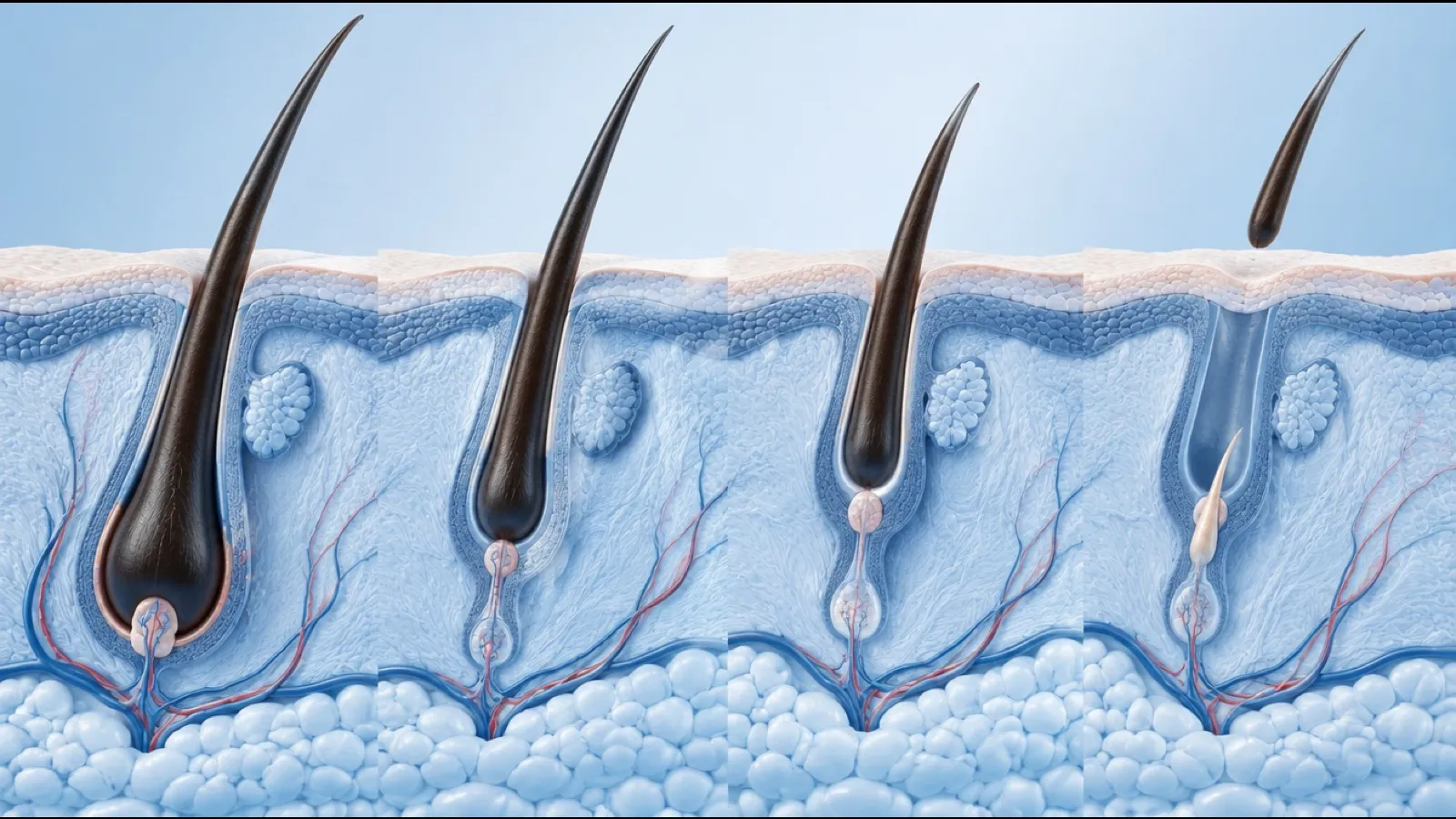
The hair growth cycle stages are anagen (growth), catagen (transition) and telogen (rest), with exogen, the release of the old hair, often counted as a fourth. Every follicle on the scalp repeats this cycle on its own schedule, so at any moment most hairs are growing while a small share is resting or shedding.
For a stylist or barber, the cycle is the single most useful piece of hair science to know. It explains why shedding shows up months after a stressful event, why some clients never get past a certain length, and why a change in shedding is worth a referral. Published sources do not agree on the exact length of each phase, so this guide attributes every range to the source it came from.
What are the hair growth cycle stages?
The hair growth cycle stages are anagen, catagen and telogen, with exogen described by many researchers as a separate shedding step. Anagen builds the hair shaft. Catagen shuts growth down. Telogen holds the finished hair in place while the follicle rests. Exogen releases it, and the follicle starts a new anagen.
The table below sets the phases side by side. Ranges are for scalp hair and are quoted from the sources listed at the end of this article.
| Phase | What happens | Duration (by source) | Share of scalp hair (by source) |
|---|---|---|---|
| Anagen (growth) | The follicle actively produces the hair shaft | Two to seven years (Cleveland Clinic; Grymowicz et al., 2020). About two to eight years (Natarelli et al., 2023) | Around 80% to 90% (Cleveland Clinic). Up to 85% to 90% (Grymowicz et al.) |
| Catagen (transition) | Growth stops and the follicle regresses. The hair becomes a club hair | About two weeks (Cleveland Clinic; Natarelli et al.). Around three weeks (Grymowicz et al.) | Around 5% (Cleveland Clinic). About 2% (Grymowicz et al.) |
| Telogen (rest) | The follicle is inactive and the club hair sits in place | Up to four months (Cleveland Clinic). About two to three months (Natarelli et al.). About three months (Grymowicz et al.) | Around 5% (Cleveland Clinic). About 9% (Natarelli et al.). 10% to 15%, with newer data suggesting 3.6% (Grymowicz et al.) |
| Exogen (release) | The old hair leaves the follicle | Not given in the sources we reviewed | Not given |
Why do the numbers differ between sources?
The figures come from different studies, different measuring methods and different populations. Counting hairs on a plucked sample gives a different answer from tracking follicles with imaging over time. Grymowicz and colleagues say this directly: the long-quoted 10% to 15% telogen figure may be an overestimate. Treat every number as a range, not a fixed rule.
What happens in anagen, catagen and telogen?
In anagen the follicle is producing hair. In catagen that production stops and the follicle shrinks back. In telogen the follicle rests with a fully formed club hair still anchored in it. The three phases run in that order, and every follicle cycles independently of its neighbors.
Anagen: the growth phase
Anagen is the longest phase and the one that sets how long a hair can get. Cleveland Clinic and a 2020 review in the International Journal of Molecular Sciences both give two to seven years for scalp hair. A 2023 review in the Journal of Clinical Medicine gives about two to eight years. That same review notes that eyebrow follicles stay in anagen for only two to three months.
Catagen: the transition phase
Catagen is brief. Sources put it at about two to three weeks. Growth stops and the lower follicle regresses. Only a small share of hairs are in catagen at any time, which is why it is rarely something you notice in the salon.
Telogen: the resting phase
In telogen the follicle is inactive. The hair is no longer growing but has not yet left the scalp. Sources give roughly two to four months. Because this phase lasts months, anything that sends extra hairs into telogen produces shedding with a delay.
What is the exogen phase?
Exogen is the point where the resting hair is released from the follicle. Some sources treat it as the end of telogen. Others, including the 2020 review by Grymowicz and colleagues, describe it as an additional distinct phase of the cycle. The sources reviewed for this article do not give it a set duration.
Exogen is the part of the cycle clients actually see. The hairs in the brush, on the cape and in the shower drain are hairs that have reached release. The American Academy of Dermatology (AAD) says it is normal to shed between 50 and 100 hairs a day. The 2023 review by Natarelli and colleagues puts normal shedding at 100 to 150 telogen hairs per day. Both are describing the same routine process with different estimates.
How long does hair grow, and how fast?
Cleveland Clinic states that hair grows about 1 centimeter per month, and that the growth phase lasts between two and seven years. Growth rate is how quickly the shaft lengthens. Growth phase length is how long the follicle keeps producing before it stops. Final length depends on both.
This is the reason behind the "my hair will not grow past my shoulders" complaint. A hair can only lengthen while its follicle is in anagen. As a rough piece of arithmetic, not a measurement: at about 1 centimeter per month, a two year growth phase allows about 24 centimeters of growth, and a seven year phase allows about 84. Two clients with identical routines can sit at opposite ends of that range.
Breakage is the other half of a length plateau. Hair that grows normally at the root but snaps along the shaft will also appear stuck. A stylist can observe breakage and adjust services. A stylist cannot determine anagen length, and should not claim to.
How do the hair growth phases explain what stylists see?
The hair growth phases explain three things stylists see every week: delayed shedding after a stressful event, length plateaus, and the difference between a hair that was shed and a hair that broke. Knowing the timing lets you ask better questions and refer with a clear reason.
Shedding that appears months after stress
The AAD lists stressors that can lead to excessive shedding, including losing 20 pounds or more, giving birth, high stress, high fever, surgery, recovering from illness and stopping birth control pills. Cleveland Clinic says the hair loss tends to happen two to three months after the stressor. The AAD says most people notice it a few months after the event.
The cycle is why. A stressor moves many growing hairs into the resting phase early, and those hairs stay put for the length of telogen before they release. When a client reports sudden shedding, ask what happened about three months ago. Our telogen effluvium guide for stylists covers this pattern in detail.
Shed hairs versus broken hairs
A shed hair that completed the cycle is full length and typically has a small pale bulb at the root end. Cleveland Clinic describes these as hairs "with white bulbs at the roots." A broken hair is shorter and has no bulb. Which one you are seeing changes the conversation. For more on telling the two apart, see hair shedding vs hair loss.
Finer hairs over time
A client whose hairs come back finer and shorter with each cycle is showing a different pattern from one who is shedding heavily. That is covered in what is hair miniaturization. You can observe and document it. The cause is for a dermatologist or physician to determine.
When should a stylist refer a client?
Refer when shedding is well above the client's normal, when it has continued for months, when there are patches, or when the scalp shows redness, scale, pain or scarring. The AAD states that a dermatologist can tell whether a person has hair loss or excessive hair shedding. Your role is to recognize, support and refer.
A simple sequence works in the chair:
- Note what you see: where, how much, shed hairs or broken hairs.
- Ask about timing and recent events without suggesting a cause.
- Tell the client that the cycle makes delayed shedding common, and that a dermatologist or physician is the right person to find the cause.
- Record your observations so you can compare at the next visit.
Professionals who want to go deeper into hair and scalp science can follow the USTI trichology pathway, which starts with the Hair Loss Practitioner course. A scalp scope helps you document what you see between visits.
The hair growth cycle stages are simple to learn and they change how you read a head of hair. Know the phases, quote the ranges with their sources, and use the timing to ask the right question before you refer.
New to the field? Start with What is trichology? or look up a term in the trichology glossary.
Sources
- Cleveland Clinic: Hair Follicle
- Cleveland Clinic: Telogen Effluvium
- American Academy of Dermatology: Do you have hair loss or hair shedding?
- Natarelli N, Gahoonia N, Sivamani RK. Integrative and Mechanistic Approach to the Hair Growth Cycle and Hair Loss. Journal of Clinical Medicine, 2023
- Grymowicz M, et al. Hormonal Effects on Hair Follicles. International Journal of Molecular Sciences, 2020
Frequently asked questions
What are the stages of the hair growth cycle?
The hair growth cycle has three core stages: anagen, the growth phase; catagen, a short transition phase; and telogen, the resting phase. Many researchers add exogen, the point where the old hair is released from the follicle. Each follicle moves through these stages on its own schedule, which is why hair does not all fall out at once.
How long does the anagen phase last?
For scalp hair, Cleveland Clinic gives two to seven years, and a 2023 review in the Journal of Clinical Medicine gives about two to eight years. The same review notes that eyebrow follicles stay in anagen for only two to three months, which is why brows stay short. Anagen length varies from person to person.
How fast does hair grow?
Cleveland Clinic states that hair grows about 1 centimeter per month. That is an average. Growth rate and the length of the growth phase differ between people, so two clients with the same routine can reach very different lengths. Breakage also affects how long hair appears to get, separate from how fast it grows at the root.
What percentage of hair is in the telogen phase?
Sources differ. Cleveland Clinic says around 5% of hairs are in telogen. A 2023 review puts it at about 9% of scalp hair. A 2020 review cites 10% to 15%, while noting that newer data suggest a figure as low as 3.6%. All of them agree that the large majority of scalp hair is in anagen.
What is the exogen phase?
Exogen is the release of the old club hair from the follicle. Some sources fold it into telogen and others describe it as a separate phase. A 2020 review in the International Journal of Molecular Sciences calls it an additional distinct phase. The hairs a client sees in the brush or shower drain are hairs that have reached this point.
Why does hair shed months after stress or illness?
A stressor can push many growing hairs into the resting phase early. Those hairs then sit in telogen before they release. Cleveland Clinic says the hair loss tends to happen two to three months after the stressor. That delay is why clients often cannot connect the shedding to its cause without prompting.
Why does my client's hair stop growing at a certain length?
Each hair grows only as long as its anagen phase lasts, and that length of time varies between people. A shorter growth phase means a shorter maximum length. Breakage along the shaft can also hold length back. If a client reports a recent change in length or density, suggest they see a dermatologist or physician.
This article is educational and is not medical advice. USTI teaches professionals to recognize, support and refer.
Turn this knowledge into a certification.
Learn hair and scalp science with USTI educators, from your first course to clinical training.
Explore trichology coursesRelated articles

Alopecia Areata: A Stylist's Guide to Bald Patches
Alopecia areata explained for stylists: the signs you may spot first, what to say when you find a bald patch on a client, cosmetic support and when to refer.
CCCA Hair Loss: Early Signs Every Stylist Should Know
CCCA hair loss often starts quietly at the crown. Learn the early signs a stylist may notice, how it differs from traction alopecia, and when to refer.
Hair Miniaturization: What It Is and What Stylists See
Hair miniaturization is the gradual shrinking of follicles so they grow shorter, finer hairs. What it may look like under a scalp scope and when to refer.