

CCCA Hair Loss: Early Signs Every Stylist Should Know
CCCA hair loss often starts quietly at the crown. Learn the early signs a stylist may notice, how it differs from traction alopecia, and when to refer.
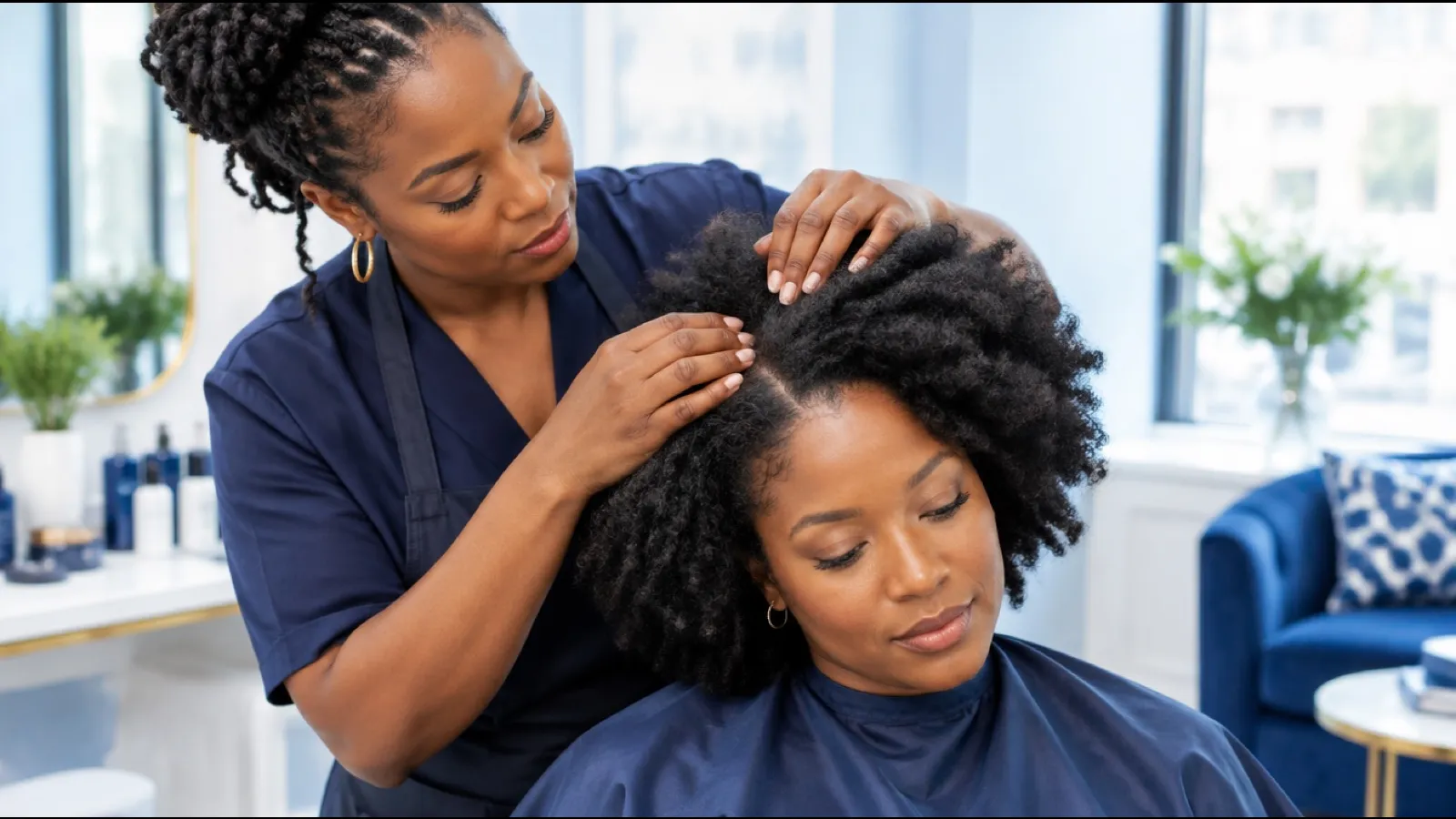
CCCA hair loss is a scarring form of alopecia that usually starts in the center of the scalp and spreads outward. Its early signs are easy to miss: breakage at the crown, a tender or itchy spot, a small area where the hair is not as dense as it was. Stylists often see these before the client does.
CCCA stands for central centrifugal cicatricial alopecia. The American Academy of Dermatology (AAD) describes it as the most common type of scarring hair loss for women of African descent. Because the crown is hard for a client to see, the person standing behind the chair has a real role. That role is to recognize, support and refer. It is never to diagnose.
What is CCCA hair loss?
CCCA is a type of alopecia in which inflammation destroys hair follicles and scar tissue replaces them. The AAD says it often begins in the center of the scalp as a small, round, balding patch that grows over time, and that it can cause permanent hair loss.
The name describes the pattern:
- Central: it starts at the crown or center of the scalp.
- Centrifugal: it spreads outward from that center.
- Cicatricial: it scars.
- Alopecia: hair loss.
According to the AAD, CCCA is more commonly seen in Black women, usually begins during middle age, and runs in families. It also develops in men and in people of all races. For how it fits with other conditions, see the types of hair loss field guide.
What are the central centrifugal cicatricial alopecia early signs?
Early signs of CCCA can include hair breakage at the crown, tiny bumps or scaling, and sensations such as itching, tenderness, burning or stinging. Visible thinning in the center of the scalp usually follows. The AAD notes that breakage may appear before any obvious hair loss.
What a stylist may notice
- Shorter, broken hairs at the crown compared with the rest of the head
- A crown area that feels less dense when you part or section
- More scalp showing in the center, in a roughly round shape
- Tiny bumps, or scaling or crusting, in the same area
- In later stages, a patch that looks shiny and smooth
What a client may tell you
- "My crown is always tender when you comb there."
- "It itches or burns in that one spot."
- "It feels like pins and needles."
- "My hair will not grow in the middle."
The AAD lists itching, pain, tenderness, burning, stinging and a pins-and-needles sensation as possible symptoms, and says they range from mild to intense enough to interfere with daily life. Some clients feel nothing. Absence of symptoms does not rule anything out.
A scalp scope lets you look closely at the crown and take dated photos. Treat what you see as an observation to pass along, not a finding.
Why does hair loss at the crown in Black women deserve a closer look?
Crown thinning has several possible causes, and CCCA is one that scars. Since the AAD identifies CCCA as the most common scarring hair loss for women of African descent, a new change at the crown in a Black client is worth a prompt dermatology visit, not a wait-and-see approach.
This is not about assuming. Crown thinning can also be pattern hair loss, breakage from many causes, or something else. A stylist cannot tell these apart, and should not try. What you can do is make sure the client knows a change is there and that a dermatologist is the right person to assess it. If possible, suggest she look for a dermatologist with experience in hair loss and textured hair.
What causes CCCA?
The AAD states that what causes the scarring is complex and not yet fully understood. Genes appear to play a part, and research is ongoing into inflammatory and autoimmune factors. Hair care practices may play a role, but the evidence does not show that they are the cause.
Here is what the AAD reports:
- Genes. CCCA runs in families. Changes to a gene called PADI3 may lead to CCCA.
- Hair care. Chemical relaxers can weaken the hair. Yet some women who develop CCCA have never used relaxers, and most women who use relaxers never develop CCCA.
- Other health conditions. In one study the AAD cites, 37% of Black women living with CCCA had type 2 diabetes, compared with 12% of Black women who did not have CCCA.
- Autoimmunity. It is possible that CCCA is an autoimmune disease, and more research is needed.
This matters for how you talk about it. Many clients assume their styling history is to blame and feel guilty before they ever sit down. The current evidence does not support telling a client that she did this to herself. She did not choose her genes, and blame delays care.
How do you tell CCCA vs traction alopecia?
CCCA usually begins in the center of the scalp and moves outward. Traction alopecia appears where hair is pulled tight, most often at the hairline. A stylist can note which pattern the loss follows, but the two can occur together and only a dermatologist can confirm either one.
| CCCA | Traction alopecia | |
|---|---|---|
| Where it usually starts | Center of the scalp or crown (AAD) | Hairline and wherever a style pulls (AAD) |
| How it spreads | Outward from the center | Stays where tension is applied |
| Cause | Complex and not fully understood (AAD) | Repeated pulling on the hair |
| Scarring | Yes | Not at first; can become permanent the longer it continues (AAD) |
| Early signs | Crown breakage, tiny bumps, scaling | Broken hairs at the forehead, receding edges, tenting |
| Sensations | Itching, tenderness, burning, stinging, pins and needles | Pain from tight styles, stinging |
| First step for the stylist | Prompt dermatology referral | Reduce tension now; refer if it does not improve or symptoms are present |
Read more on the hairline pattern in traction alopecia early signs.
What are the scarring alopecia signs that mean refer now?
Refer promptly when thinning or breakage at the crown comes with tenderness, burning, itching, bumps, crusting, or a shiny smooth area of scalp. These can be scarring alopecia signs. The AAD states that once a follicle is destroyed it is replaced by scar tissue, so time matters.
The AAD says starting treatment early can prevent CCCA from spreading outward and causing more permanent hair loss, and that some people have regrowth when treatment starts early. Without treatment, it says, CCCA often continues to destroy follicles and the patch grows. A referral made three appointments late can mean a larger permanent patch.
More referral triggers are listed in when to refer a client to a dermatologist.
What should a stylist say and do?
Say what you see in plain words, ask about symptoms, and recommend a dermatologist soon. Keep blame out of it. Then adjust your service so it is gentle on the area, and keep records the client can take to the appointment.
- Choose a private moment. Lower your voice or step away from a busy floor.
- Describe, do not label. "I am seeing some breakage and less density right at your crown. It looks different from your last visit."
- Ask about feeling. "Has this spot been tender, itchy or burning?"
- Refer clearly. "I cannot tell you what it is, and I do not want to guess. A dermatologist can. I would book that soon, because some kinds of hair loss are easier to manage early."
- Offer records. Share dated photos and your notes.
- Be gentle in service. Keep tension and heat low at the crown, and ask the client to tell you if anything hurts. Follow whatever her dermatologist advises about styling.
- Follow up. Ask at the next visit whether she got an appointment.
Avoid three things: naming CCCA as a fact, recommending products or treatments for it, and saying the hair will grow back. For more wording, see how to talk to a client about hair loss.
How can stylists learn to catch CCCA hair loss earlier?
Check the crown on every client, every visit, and learn what a healthy crown looks like on each hair type you serve. CCCA hair loss is caught early by professionals who look on purpose and who know that tenderness plus crown breakage is a reason to speak up.
Structured education helps. USTI's trichology pathway begins with the Hair Loss Practitioner course and covers scalp observation, documentation and referral. Trichology training does not qualify anyone to diagnose or treat CCCA. It prepares you to recognize the early signs, support the client with respect, and refer to a dermatologist while follicles can still be saved.
New to the field? Start with What is trichology? or look up a term in the trichology glossary.
Sources
- American Academy of Dermatology: Central centrifugal cicatricial alopecia (CCCA) overview
- American Academy of Dermatology: CCCA signs and symptoms
- American Academy of Dermatology: CCCA causes
- American Academy of Dermatology: Hairstyles that pull can lead to hair loss
- American Academy of Dermatology: Hair loss, who gets and causes
Frequently asked questions
What is CCCA hair loss?
CCCA stands for central centrifugal cicatricial alopecia. It is a scarring type of hair loss in which inflammation destroys hair follicles and scar tissue replaces them. According to the American Academy of Dermatology, it often begins in the center of the scalp as a small round patch that grows over time, and it can cause permanent hair loss.
What are the early signs of CCCA?
The American Academy of Dermatology lists hair breakage in the center of the scalp as a possible early sign. Clients may also notice tiny bumps, scaling, itching, tenderness, burning, stinging or a pins-and-needles feeling. Some people have no symptoms at all. Visible thinning at the crown usually follows and spreads outward.
Is CCCA caused by relaxers or tight hairstyles?
The American Academy of Dermatology says the cause is complex and not yet fully understood. Hair care practices may play a role, but the evidence is not conclusive. The AAD notes that some women who develop CCCA have never used relaxers, and most women who use relaxers never develop CCCA. Genes also appear to be involved.
How is CCCA different from traction alopecia?
CCCA usually starts in the center of the scalp and spreads outward, and it is a scarring condition. Traction alopecia shows up where hair is pulled tight, most often along the hairline, and is caused by repeated tension. The two can exist together. Only a dermatologist can tell them apart with certainty, sometimes with a biopsy.
Can hair grow back with CCCA?
Hair cannot regrow from follicles that have been destroyed and replaced by scar tissue. The American Academy of Dermatology says that starting treatment early can prevent CCCA from spreading, and that some people have regrowth when treatment starts early. That is why a prompt dermatology visit matters more than waiting to see what happens.
What should a stylist say to a client who may have CCCA?
Describe what you see without naming a condition or assigning blame. For example: I am noticing some breakage and thinning at your crown that was not here before. Has it felt tender or itchy? I would like you to have a dermatologist look at it soon. Then offer to share photos and dates for the appointment.
Who gets CCCA?
The American Academy of Dermatology states CCCA is more commonly seen in Black women, usually begins during middle age, and runs in families. It also develops in men and in people of all races. A stylist should not rule it out based on a client's age, sex or hair care history.
This article is educational and is not medical advice. USTI teaches professionals to recognize, support and refer.
Turn this knowledge into a certification.
Learn hair and scalp science with USTI educators, from your first course to clinical training.
Explore trichology coursesRelated articles

Alopecia Areata: A Stylist's Guide to Bald Patches
Alopecia areata explained for stylists: the signs you may spot first, what to say when you find a bald patch on a client, cosmetic support and when to refer.
Hair Growth Cycle Stages: Anagen, Catagen, Telogen, Exogen
The hair growth cycle stages explained for stylists: anagen, catagen, telogen and exogen, how long each lasts by source and what the cycle means at the chair.
Hair Miniaturization: What It Is and What Stylists See
Hair miniaturization is the gradual shrinking of follicles so they grow shorter, finer hairs. What it may look like under a scalp scope and when to refer.