

Do Trichologists Need a License? US Rules Explained
Do trichologists need a license in the US? Learn how certification differs from licensure, why state rules vary, and what a trichologist's scope covers.
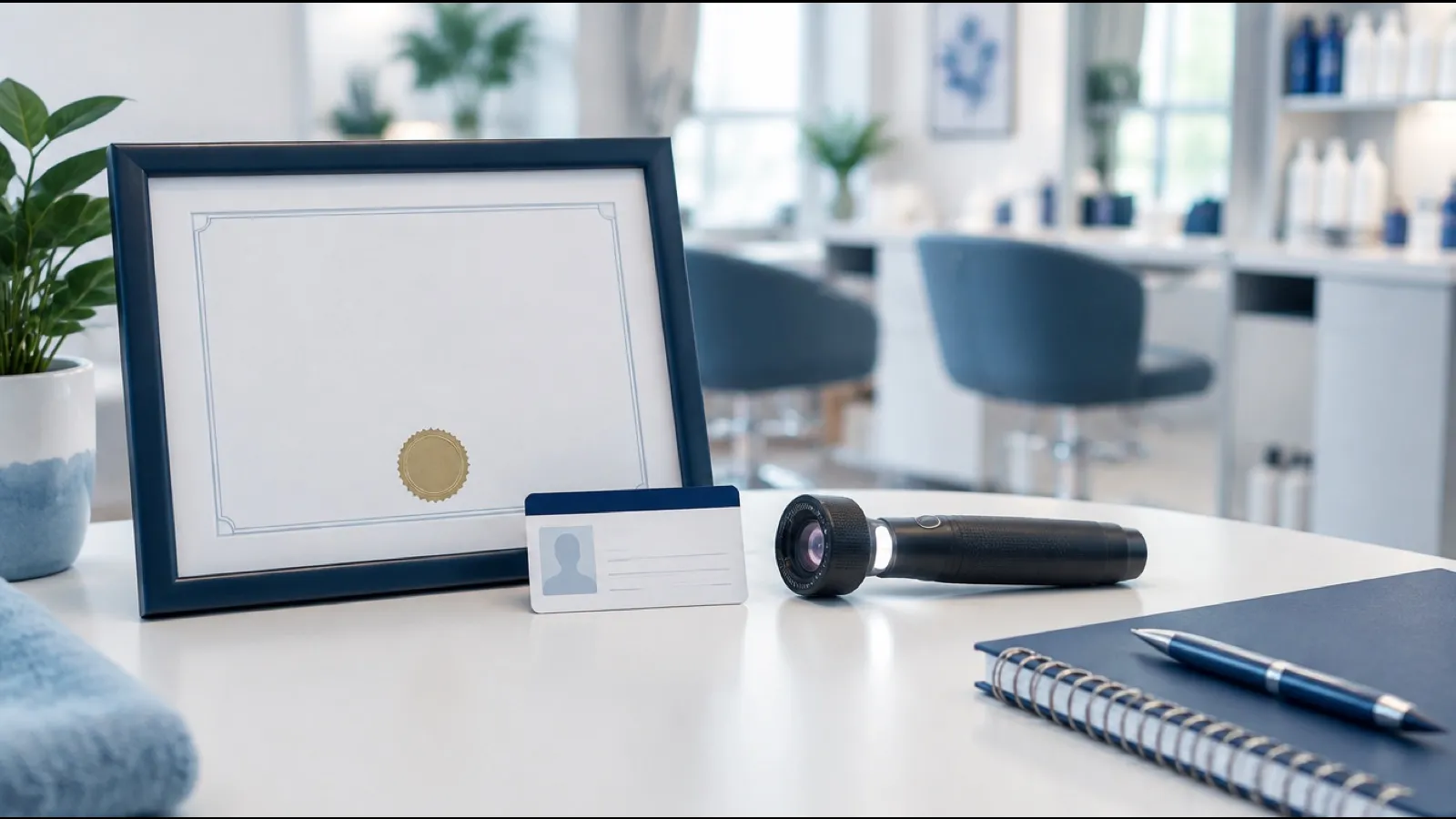
Do trichologists need a license? In the US, "trichologist" is not a state-licensed medical title, so the title itself comes from professional certification rather than a state license. The hands-on services a trichologist performs are a separate matter. Many of them may require a cosmetology or barber license, depending on the state. This guide explains the difference and how to check the rules where you work.
Do trichologists need a license in the US?
The title does not come from a state license, but the work may require one. Trichologists earn certification from independent certifying organizations. Whether you also need a cosmetology or barber license depends on your state and on the services you offer, especially anything that involves touching a client's hair or scalp.
So the honest answer has two parts:
- For the title: trichologists are certified, not licensed as medical providers. They are not physicians.
- For the services: state law decides. If a service falls inside your state's definition of cosmetology or barbering, you generally need that license to perform it for pay.
This is why two certified trichologists in different states, or with different base licenses, may offer different service menus.
Is trichology regulated in the US?
Trichology as a title is not regulated like medicine, but trichology practice sits between two sets of state rules. Cosmetology and barbering laws regulate many hands-on hair and scalp services. Medical practice laws reserve diagnosis, prescribing and medical procedures for licensed medical providers. A trichologist must stay inside both.
State cosmetology and barbering boards
Each state writes its own definition of cosmetology and barbering. Many include scalp services. California is one example. Its Business and Professions Code section 7316 defines cosmetology to include "massaging, cleaning, or stimulating the scalp, face, neck, arms, or upper part of the human body, by means of the hands, devices, apparatus or appliances, with or without the use of cosmetic preparations, antiseptics, tonics, lotions, or creams." The same section defines barbering to include "giving facial and scalp massages or treatments with oils, creams, lotions, or other preparations either by hand or mechanical appliances."
Other states use different wording, and exemptions vary. Do not assume your state matches California or any other.
Medical practice rules
Diagnosing disease and prescribing medication belong to physicians and other licensed medical providers. WebMD puts it directly: because trichologists are not physicians, they cannot prescribe drugs or perform medical or surgical procedures. No certification changes that.
What certifying bodies say
Certifying organizations point candidates back to state law. The American Medical Certification Association, which offers trichology certification exams, states that "the laws and regulations pertaining to minimum requirements and the allied health industry vary by state" and recommends that candidates learn their own state's rules.
What is the difference between trichology certification and a license?
Certification is a professional credential that shows you completed training and passed an exam. A license is legal permission from a state government to perform regulated services. Certification shows what you know. A license controls what you may legally do. One does not replace the other.
Trichology certification vs license
| Certification | License | |
|---|---|---|
| Issued by | Independent certifying body | State government board |
| What it shows | You met that body's training or exam standard | You have legal permission to perform regulated services |
| Example | AMCA Associate Trichologist Certification or Trichologist Certification | State cosmetology license, barber license, medical license |
| Required by law | Generally no | Yes, for services the state regulates |
| Changes your legal scope | No | Yes |
| How to verify | Ask the certifying body | Look up the license on the state board website |
AMCA lists two trichology exams: the Associate Trichologist Certification with 100 questions and the Trichologist Certification with 200 questions. Passing either shows knowledge. Neither is a state license.
In the US the accurate title is certified trichologist. If a professional also holds a cosmetology, barber or medical license, they can name that license alongside it.
Can you work as a trichologist without a cosmetology license?
It depends on your state and your service menu. You can study trichology and hold a certification without a cosmetology license. Hands-on services such as scalp treatments, cleansing and massage may fall under cosmetology or barbering law in your state. Confirm with your state board before you offer them.
Services that often raise licensing questions
- Scalp treatments, exfoliation, cleansing and massage
- Applying products to the hair or scalp
- Using devices or appliances on the scalp
- Cutting, styling or chemical services
- Head spa services. See how to start a head spa business
Activities to ask your board about
Consultation, education and visual assessment are treated differently from state to state. Do not assume they are exempt. Ask the board directly and describe exactly what you plan to do, including whether you touch the scalp or use a scalp scope.
How to check your state rules
- Find your state's cosmetology or barbering board website.
- Read the statutory definition of cosmetology and barbering. Look for the words scalp, massage, treatment and device.
- Read the list of exemptions.
- Email the board with a specific description of your planned services and ask whether a license is required. Keep the written reply.
- Ask where the services may be performed. Some states also require an establishment license for the location.
- Recheck when laws change or when you add a service.
If you already hold a cosmetology or barber license, trichology training builds on a legal base you have. Our guides on whether a cosmetologist can become a trichologist and trichology for barbers cover those routes.
What is a trichologist's scope of practice?
A trichologist's scope of practice is non-medical. It covers hair and scalp assessment, client education, supportive care allowed by state rules, and referral to a dermatologist or physician. It does not include diagnosing disease, prescribing medication or performing medical procedures. The working rule is recognize, support, refer.
Recognize
Observe and document. Take a thorough history, examine the hair and scalp, and note signs that are associated with common conditions. Describe what you see. Do not name a disease as a confirmed finding.
Support
Help within your training and your state's rules. This may include education on scalp care and styling habits, non-medical scalp services your license permits, and progress tracking with photos.
Refer
Send the client to a dermatologist or physician when a concern may be medical. Sudden or patchy loss, pain, sores, scarring and signs of infection all call for referral. See when to refer a client to a dermatologist.
Can trichologists prescribe medication?
No. Trichologists cannot prescribe medication, and they should not advise clients to start, stop or change any medication. Those decisions belong to the client's physician. For a side-by-side view of the two roles, read trichologist vs dermatologist.
Outside scope for every trichologist
- Telling a client they have a specific disease
- Ordering or interpreting blood tests or biopsies
- Prescribing or dispensing prescription medication
- Injections, surgery or other medical procedures
- Promising to cure or reverse hair loss
What should you do before offering trichology services?
Confirm your state's rules in writing, hold the license your services require, earn a certification from a program that teaches scope clearly, and describe your credentials accurately. These four steps protect your clients and your business, and they apply whether you work in a salon, a barbershop or a dedicated practice.
A program worth your time teaches scope from the start. The USTI trichology pathway runs in three steps: the Hair Loss Practitioner course, then Associate Trichologist, then Clinical training, with certification exams through the AMCA. For the full route, see how to become a trichologist. More common questions are answered in the USTI FAQ.
So, do trichologists need a license? Not for the title, which is a certification. Possibly for the services, which your state board decides. Check the law where you work, stay inside recognize, support, refer, and state your credentials exactly as they are.
New to the field? Start with What is trichology? or look up a term in the trichology glossary.
Sources
- American Medical Certification Association, Trichologist Certification (TC): https://www.amcaexams.com/certifications/trichologist-certification/
- American Medical Certification Association, Associate Trichologist Certification (ATC): https://www.amcaexams.com/certifications/associate-trichologist-certification/
- California Business and Professions Code section 7316: https://leginfo.legislature.ca.gov/faces/codes_displaySection.xhtml?lawCode=BPC§ionNum=7316
- California Board of Barbering and Cosmetology, consumer information: https://www.barbercosmo.ca.gov/consumers/index.shtml
- WebMD, "What Is a Trichologist?": https://www.webmd.com/a-to-z-guides/what-is-a-trichologist
Frequently asked questions
Do trichologists need a license in the US?
Trichologist is not a state-licensed medical title in the US, so the title itself does not come from a state license. What you may need is a cosmetology or barber license for hands-on hair and scalp services, depending on your state. Contact your state board to confirm which services are regulated where you work.
Is trichology regulated in the US?
Trichology as a title is not regulated the way medicine is, but the services a trichologist performs can be. State cosmetology and barbering laws regulate many hands-on hair and scalp services, and state medical practice laws reserve diagnosis and prescribing for licensed medical providers. Both sets of rules shape what a trichologist can do.
Can trichologists prescribe medication?
No. Trichologists are not physicians, and WebMD states they cannot prescribe drugs or perform medical or surgical procedures. Prescription treatment is managed by dermatologists and other licensed medical providers. A trichologist who believes a client may need medical care should refer that client to a physician.
Can you be a trichologist without a cosmetology license?
You can study trichology and earn a certification without a cosmetology license. Whether you can perform hands-on scalp services without one depends on your state's law. Some state definitions of cosmetology include scalp treatments, so ask your state board in writing before offering any service that involves touching a client's hair or scalp.
What is the difference between trichology certification and a license?
Certification is a professional credential showing you completed training and passed an exam. A license is legal permission from a state to perform regulated services. A trichology certification shows knowledge. It does not replace a cosmetology, barber or medical license, and it does not expand what your state allows you to do.
What is a trichologist's scope of practice?
A trichologist's scope is non-medical: assess the hair and scalp, educate the client, provide supportive care permitted by state rules, and refer to a dermatologist or physician when something may be medical. Trichologists do not diagnose disease, prescribe medication or perform medical procedures. The short version is recognize, support, refer.
This article is educational and is not medical advice. USTI teaches professionals to recognize, support and refer.
Turn this knowledge into a certification.
Learn hair and scalp science with USTI educators, from your first course to clinical training.
Explore trichology coursesRelated articles

Trichology vs Cosmetology: What Is the Difference?
Trichology vs cosmetology: how the two differ in focus, training, licensing and services, what cosmetology school teaches about the scalp, and how they combine.

Associate Trichologist Certification: AMCA Exam Guide
Associate Trichologist Certification exam guide: AMCA format, 100 questions, 2 hours, remote proctoring, the seven topic areas and a four-week study plan.
Can a Cosmetologist Become a Trichologist? Yes: How
Can a cosmetologist become a trichologist? Yes. See the certification pathway for licensed stylists, what changes behind the chair, and how titles compare.