

How to Start a Head Spa Business: Licensing, Pricing, Steps
How to start a head spa business: what a head spa is, licensing by state board, building a price ladder, scalp science training, and claims you cannot make.
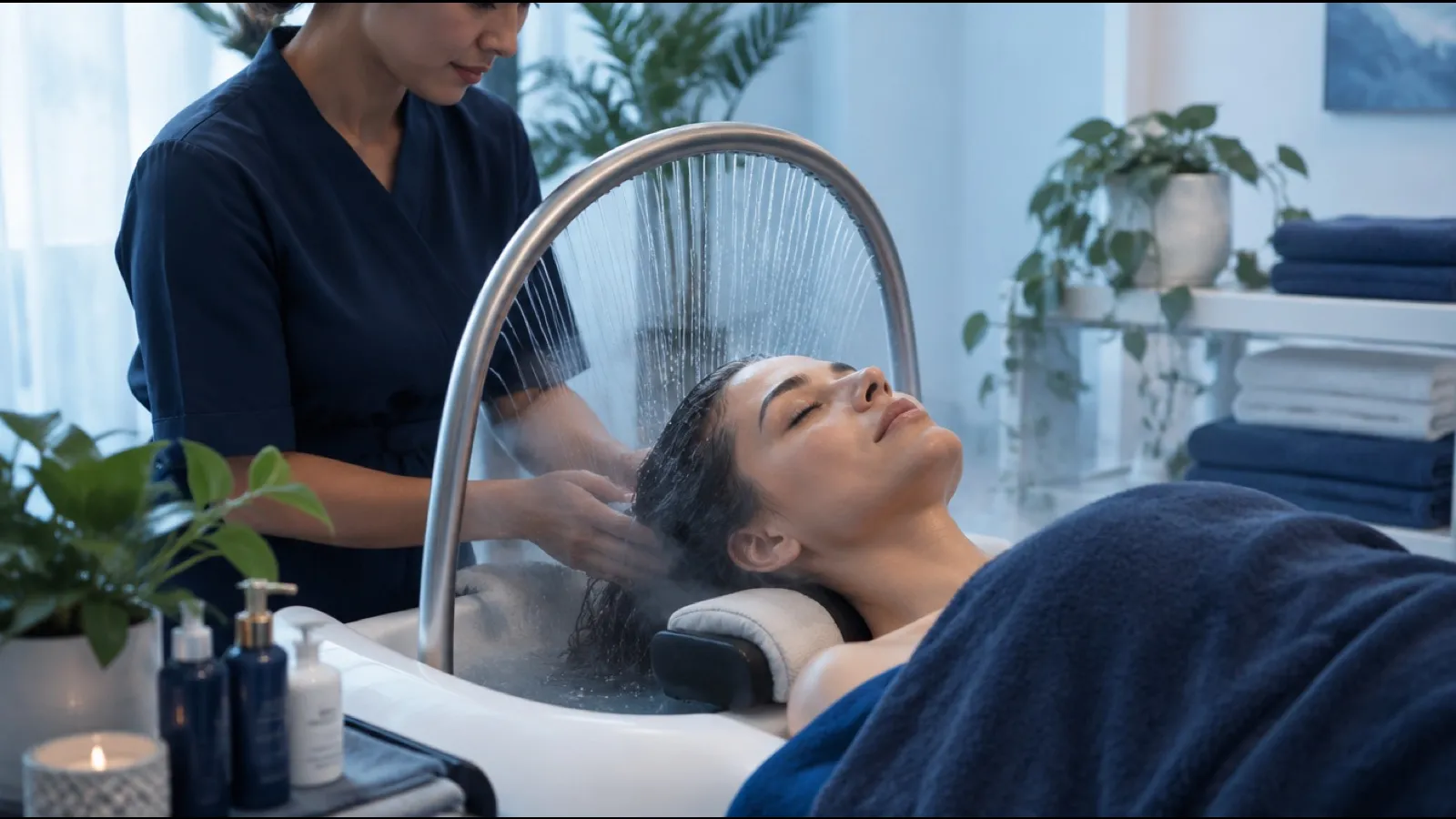
To start a head spa business, you need the right state license for the services you plan to perform, a short menu of scalp services priced from your real costs, training in scalp science, and marketing that makes no medical claims. Most owners begin by adding one scalp treatment to an existing salon menu, then expand once demand is proven.
This guide covers how to start a head spa business in the order the decisions come up: what the service is, what your state board allows, how to launch, how to price, and what you can and cannot say.
What is a head spa?
A head spa is a cosmetic service, or a business built around that service, focused on cleansing and caring for the scalp. California's Board of Barbering and Cosmetology describes head spas as establishments specializing in "scalp facials" that offer services focused on scalp and hair health. It is not a medical treatment.
In a November 2024 industry bulletin, the California board listed what head spas often provide:
- Cleansing, steaming and exfoliation to remove buildup and oils
- Scalp massage
- Neck, shoulder and facial massage for relaxation
- Hair masks for deep conditioning
- Shampooing and blow-drying hair
Many head spas also show clients magnified images of their scalp before and after the service. That is where the business moves from relaxation toward something that looks clinical, and where training and careful wording start to matter.
Do you need a license for head spa services?
Usually yes, and the answer depends on your state. Hands-on scalp and hair services generally fall under cosmetology, barber or esthetics board rules, and the location typically needs an establishment license. Which license covers which part of a head spa service varies, so confirm with your state board before you sign a lease.
One state's example: California
California is useful because its board has addressed head spas directly. The November 2024 bulletin states that estheticians may perform facials and various scalp treatments, but they are not licensed to provide shampooing or blow-drying services. Those must be performed by a licensed barber, cosmetologist or hairstylist. The bulletin adds that a licensee must limit their practice to the areas for which they are licensed.
That single rule changes staffing. A California head spa that shampoos as part of the service needs a barber, cosmetologist or hairstylist doing that step.
Do not assume your state matches California. Other states define shampooing, scalp treatment and massage differently.
Questions to ask your state board
- Which license types may perform scalp cleansing, exfoliation and steaming?
- Who may shampoo and blow-dry?
- Does neck and shoulder massage require a massage therapy license?
- What establishment license does the location need, and what are the sanitation and equipment rules?
- Are there rules on using a scalp camera or on the words I use in advertising?
Get the answers in writing and keep them on file.
Is head spa certification the same as a license?
No. A head spa certification shows you completed specialized training. It does not authorize you to perform services that your state reserves for licensed professionals. "Trichologist" is also not a state-licensed title in the US. For more on that, see do trichologists need a license.
What are the steps to start a head spa business?
Confirm your license, define a small menu, set up the room, write a consultation protocol, price from costs, train, and launch to your existing clients first. Testing the service inside a working salon before committing to a stand-alone location keeps your risk low and tells you what clients will pay for.
- Confirm licensing. Ask your state board the questions above. Match each step of the service to a license held by the person doing it.
- Decide the model. Add scalp treatments to a salon menu, convert one room, or open a stand-alone head spa. Starting as an add-on needs the least capital.
- Design three services. A short add-on, an express service and a full signature service. More on this under pricing.
- Set up the space. You need a comfortable shampoo or treatment bed, good water access, product storage, and sanitation that meets your board's rules. Buy equipment after you have tested the service flow, not before.
- Write your consultation protocol. Intake questions, a scalp check, photos with consent, and a clear rule for when you stop and refer. Our guide to scalp analysis for hairstylists gives a step-by-step version.
- Handle the business basics. Business registration, liability insurance, a booking system and consent forms. Requirements differ by state and city, so check locally.
- Train everyone who touches a scalp. Technique and scalp science both.
- Soft launch. Offer the service to current clients, time every step, ask for feedback, then set final prices and open bookings.
How much should you charge for head spa services?
Charge what your costs and local market support. Work out the cost of one service from time, product, equipment and overhead, then build a three-step price ladder: add-on, express and signature. Published data from 2024 put average head spa prices in four large US cities between $103 and $195.
That figure comes from a paper in the Journal of Drugs in Dermatology (September 2025). The authors searched for head spas in New York, Los Angeles, Miami and Dallas between July and August 2024 and evaluated 30 of them. The average lowest to highest price point was $103 to $195. These are big-city prices from one small sample, so treat them as a reference point and not a target.
How to build a scalp treatment pricing ladder
| Tier | What it is | Who it is for | How to price it |
|---|---|---|---|
| Add-on | A short scalp cleanse or massage attached to a cut or color | Existing clients trying it for the first time | Product cost plus the extra minutes at your chair rate |
| Express | A stand-alone service with consultation, cleanse and massage | Clients who want the experience in a short visit | Full time at your hourly target, plus product |
| Signature | The full service: consultation, scope images, exfoliation, steam, mask, massage, blow-dry | Clients booking it as a destination treatment | Full time, product, equipment cost, and a premium for the room |
Work out your number
- Decide the hourly revenue the chair or room must earn to cover rent, wages, supplies and profit.
- Time each service honestly, including setup, cleanup and consultation.
- Add the product cost per service.
- Compare with local competitors and adjust.
The add-on exists to introduce clients to the service. The signature service is where the margin is. If you want to add scalp treatments to a salon menu without a remodel, the add-on and express tiers are enough to begin.
Why does scalp science training matter for a head spa?
Because a head spa puts a magnified scalp on a screen in front of a paying client, and the client will ask what it means. Without training, staff either guess or give advice they are not qualified to give. With training, they can describe what is visible, provide the service safely, and refer when needed.
The Journal of Drugs in Dermatology paper raises this concern. Its authors collected 165 scalp photographs posted by the head spas they reviewed. Only 3 of the 30 businesses listed someone described as a trichologist. The authors noted that head spa technicians may obtain a certificate in trichology, though this is neither required nor common.
The practical lesson is to know what you are looking at and know where your role ends. Some clients who book a scalp treatment have a medical condition. Staff should recognize red flags such as smooth bald patches, pustules, open sores or scalp pain, pause the service where appropriate, and send the client to a dermatologist. See when to refer a client to a dermatologist for the checklist and scripts.
USTI's scalp health courses are built for this kind of service. Professionals who want to go further can follow the trichology pathway: the Hair Loss Practitioner course, then Associate Trichologist, then Clinical training, with certification exams through the AMCA (American Medical Certification Association). Mentorship is available for owners building a scalp-focused practice.
What can a head spa claim, and what can it not claim?
A head spa can describe what the service does at a cosmetic level: it cleanses the scalp, removes buildup, and feels relaxing. It cannot claim to regrow hair, stop hair loss, or treat, cure or diagnose any condition. Those are medical claims, and they create legal risk for the business.
Two federal sources set the line. The FDA states that claims that a product will restore hair growth establish it as a drug, because the intended use is to treat disease or affect the structure or function of the body. The FTC's Health Products Compliance Guidance says health-related claims require competent and reliable scientific evidence.
| You can say | Do not say |
|---|---|
| "Deep cleanses the scalp and removes product buildup" | "Unclogs follicles to regrow hair" |
| "A relaxing scalp massage" | "Stimulates hair growth" |
| "We show you magnified images of your scalp" | "We diagnose your scalp condition" |
| "Leaves the scalp feeling clean and comfortable" | "Treats dandruff, psoriasis or hair loss" |
| "If we see anything that needs medical attention, we will refer you" | "No need to see a doctor" |
Apply the same rule to before-and-after photos, social captions and what staff say in the room. A photo of a cleaner scalp is fine. A caption that implies the treatment fixed a medical problem is not.
If you are working out how to start a head spa business, the order matters: license first, then a small tested menu, prices built from your own costs, trained staff, and honest claims. Owners who get those five right have a service clients rebook and a business that stays on the right side of their state board.
New to the field? Start with What is trichology? or look up a term in the trichology glossary.
Sources
- California Board of Barbering and Cosmetology: Industry Bulletin, Head Spas (November 2024)
- Johnson CE, Palmer V, Hordinsky M, McMichael A. Trichoscopic Images Observed in Popular Head Spa Salons: Are We Headed in the Right Direction? Journal of Drugs in Dermatology, September 2025.
- US Food and Drug Administration: Is It a Cosmetic, a Drug, or Both? (Or Is It Soap?)
- Federal Trade Commission: Health Products Compliance Guidance
- American Academy of Dermatology: Central centrifugal cicatricial alopecia (CCCA)
Frequently asked questions
What is a head spa?
A head spa is a salon service or stand-alone business focused on the scalp. California's Board of Barbering and Cosmetology describes head spas as establishments specializing in scalp facials, with services such as cleansing, steaming, exfoliation, scalp massage, hair masks, shampooing and blow-drying. It is a cosmetic and relaxation service, not a medical treatment.
Do you need a license for head spa services?
In most cases, yes, but the rules vary by state. Hands-on scalp and hair services generally fall under cosmetology, barber or esthetics board rules, and the business itself usually needs an establishment license. Which license covers shampooing, scalp treatments or massage differs by state, so confirm in writing with your state board before you open.
Is head spa certification required?
A head spa certificate from a private training provider is not the same as a state license and does not replace one. A 2025 Journal of Drugs in Dermatology paper noted that head spa technicians may obtain a trichology certificate, though this is neither required nor common. Training is still valuable because it teaches you what you are looking at.
How much should I charge for head spa services?
Build your price from your own costs: time in the chair, product used, equipment, rent and the wage you need. Then check local competitors. For reference, a 2025 Journal of Drugs in Dermatology paper found average prices from $103 to $195 across 30 head spas in New York, Los Angeles, Miami and Dallas, based on mid-2024 searches.
Can an esthetician open a head spa?
It depends on the state and the services offered. In California, the Board of Barbering and Cosmetology says estheticians may perform facials and various scalp treatments but are not licensed to shampoo or blow-dry hair, which must be done by a licensed barber, cosmetologist or hairstylist. Other states draw the line differently. Ask your own board.
Can a head spa say its treatments help hair growth?
No. A head spa should not claim to regrow hair, stop hair loss or treat any scalp condition. The FDA states that claims such as restoring hair growth establish a product as a drug, and the FTC requires competent and reliable scientific evidence for health claims. Describe the service as cleansing, comfort and scalp care.
This article is educational and is not medical advice. USTI teaches professionals to recognize, support and refer.
Turn this knowledge into a certification.
Learn hair and scalp science with USTI educators, from your first course to clinical training.
Explore trichology coursesRelated articles
Do You Need a License for a Head Spa? Rules by State
Do you need a license for head spa services? See which licenses cover scalp work, what four states say in writing, and the questions to ask your board.
How Much to Charge for Head Spa Services: Pricing Guide
How much to charge for head spa services: a cost-based pricing formula, a four-tier service menu, and the one published US price range to benchmark against.

How to Add Scalp Treatments to a Salon Menu: A Guide
How to add scalp treatments to a salon menu: start with a consultation and scope check, then build service tiers, train staff and avoid medical claims.