

Scalp Analysis for Hairstylists: A Step-by-Step Protocol
Scalp analysis for hairstylists, step by step: intake questions, visual check, scope check, photos, how to explain findings without diagnosing, and referral.
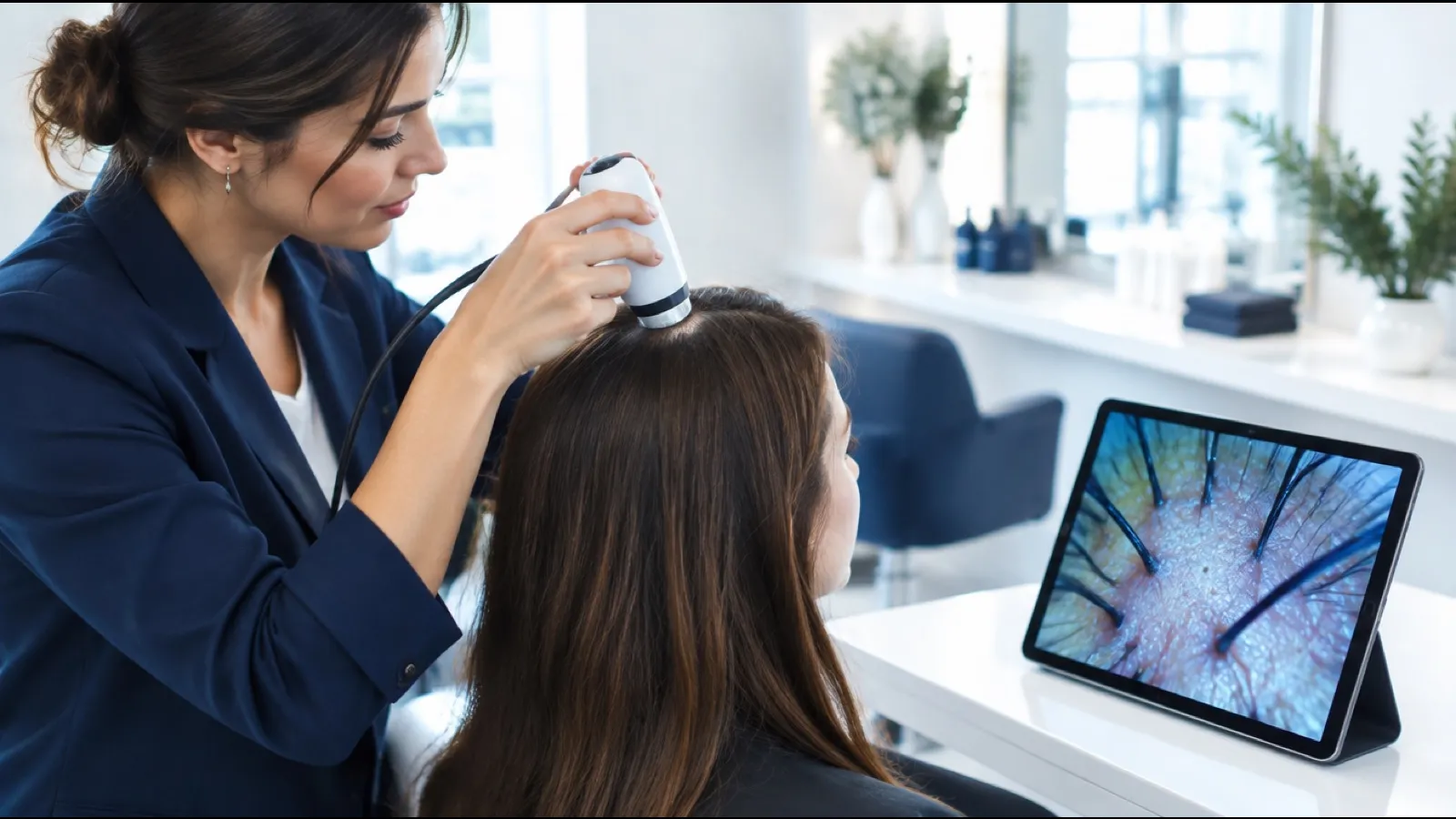
Scalp analysis for hairstylists is a structured look at the scalp and hair: you ask intake questions, check the scalp with your eyes and then a scope, photograph what you see, explain it in plain words, and refer anything that looks medical. It is observation and documentation. It is not diagnosis.
That boundary is what makes the service worth offering. A stylist sees the same scalp every few weeks, often from angles the client never sees. A consistent protocol turns that access into a record a client can act on.
What is a scalp analysis, and is it the same as trichoscopy?
No. Trichoscopy is the medical term for examining the hair and scalp with a dermoscope, and physicians use it as a diagnostic method. A salon scalp analysis may use a similar magnifying camera, but it is observational: the professional records what is visible, supports cosmetic scalp care, and refers suspected medical conditions to a dermatologist.
The word trichoscopy was coined by Rudnicka and Olszewska in 2006 for dermoscopy of the hair and scalp, according to a study in the International Journal of Trichology. In a clinic, the physician combines those images with medical history, examination and sometimes lab work or a biopsy to reach a diagnosis.
Scalp analysis vs trichoscopy
| Salon scalp analysis | Trichoscopy | |
|---|---|---|
| Who does it | Hairstylist, barber, cosmetologist, trichologist | Dermatologist or other physician |
| Purpose | Observe, document, guide cosmetic care, decide on referral | Help diagnose hair and scalp disorders |
| Output | Notes and photos in the client record | A medical diagnosis and treatment plan |
| What happens next | Scalp care within your license, or referral | Medical treatment or further testing |
The tool can look the same in both columns. The training, the purpose and the legal authority are not. Trichologists are not physicians either, and "trichologist" is not a state-licensed medical title in the US. The role for every non-physician is the same: recognize, support, refer.
How do you do a scalp analysis step by step?
Work through six steps in the same order every time: intake questions, a naked-eye visual check, a part-by-part scope check, photos, a plain-language explanation, and a referral decision. Keeping the order fixed means two visits can be compared, and nothing gets skipped when the salon is busy.
1. Ask the intake questions
Do this before the client is shampooed, with the scalp in its everyday state. Write the answers down.
- What have you noticed, and when did it start?
- Is it getting worse, staying the same, or coming and going?
- Any itch, pain, burning or tenderness?
- Any illness, surgery, childbirth, major stress or significant weight loss in recent months? The American Academy of Dermatology (AAD) lists these among the stressors linked to excessive hair shedding.
- Any new medications or diagnosed health conditions? Record only what the client offers. Do not advise on medication.
- What is your routine: wash frequency, products, heat, chemical services, tight styles, extensions?
- Has anyone in your family had hair loss?
2. Do a visual check without the scope
Look at the whole head in good light before you magnify anything. Check the hairline, temples, part line, crown and nape. Check the eyebrows too. Note overall density, any patches, the width of the part, broken hairs, flaking, redness, and anything the client flinches at when you touch it.
3. Do a part-by-part scope check
Use a fixed map so every client gets the same scan. A simple one:
- Front hairline, center
- Left temple
- Right temple
- Mid-scalp along the part
- Crown
- Nape
- Any area the client is worried about
At each zone, make a clean part and look at four things: the scalp surface (color, flaking, oil, buildup), the follicle openings (are they visible, and how many hairs come from each), the hair shafts (are they similar in thickness or mixed), and anything that looks different from the zones around it.
Record what you see in descriptive words. "Yellowish scale around follicle openings at the crown" is an observation. "Seborrheic dermatitis" is a diagnosis, and it is not yours to make. For help telling common flaking patterns apart at the observation level, see our guide to dandruff vs dry scalp vs buildup.
4. Document with photos
Take one wide photo and one magnified photo per zone. Keep these constant at every visit:
- The same zones, in the same order
- The same magnification setting
- The same light mode
- The same hair state (dry, unwashed is easiest to repeat)
Label each image with the date and the zone. Get written consent to take and store photos, and store them where only the people who need them can see them.
5. Explain findings without diagnosing
Show the client the images and describe them. Three sentence patterns keep you inside your role:
- "Here is what I can see: ..."
- "Compared with your last visit, this area looks ..."
- "I can't tell you what is causing this. A dermatologist can."
Avoid condition names, avoid predicting outcomes, and never suggest a medication or supplement dose.
6. Decide: support or refer
If what you see is cosmetic, such as product buildup or mild dryness, support it with services and home care that your license covers. If you see a red flag, refer. Red flags include smooth bald patches, sudden heavy shedding, pain or burning, pustules or crusting, shiny skin where follicle openings are no longer visible, and hairline loss together with eyebrow loss.
Speed matters with scarring types of hair loss. The AAD states that once a hair follicle scars, it can no longer grow hair. The full checklist, scripts and a referral note template are in when to refer a client to a dermatologist.
What should you look for in a scalp camera for a salon?
Compare four features: magnification range, light type (polarized or non-polarized), how the device connects to a phone or tablet, and how it captures and stores images. No single specification is required for salon scalp analysis, so judge each device on whether it gives you clear, repeatable photos of the same zones over time.
Sellers use several names for much the same kind of tool: scalp camera, scalp scope, scalp microscope, trichoscope. The label matters less than the features below.
| Feature | What it means | What to check before buying |
|---|---|---|
| Magnification range | How much the image is enlarged. Medical literature describes handheld dermoscopes at about 10x and videodermoscopes with lenses from 20x to 1000x. | Whether the stated range covers both a wide view of a part line and a close view of follicle openings. Ask to see sample images at each setting. |
| Polarized vs non-polarized light | Polarized light cuts surface glare. Non-polarized light is usually used in contact with the skin. | Which modes the device has and whether you can switch between them. |
| Phone or tablet connection | How the image reaches a screen: cable, Wi-Fi or a built-in display. | Compatibility with the devices you already own, and whether the client can see the screen from the chair. |
| Image capture | Whether you can save stills, label them and compare visits. | Where images are stored, how they are exported, and who can access them. |
Does polarized light matter?
It changes what you can see. A 2014 study in the International Journal of Trichology compared the two modes and reported that vascular patterns, scaling and pigment patterns were better appreciated in polarized mode, while black dots and tapered hairs were better documented in non-polarized mode. Those are findings from medical trichoscopy, but the practical point carries over: use the same light mode for every follow-up photo so you are comparing like with like.
You can compare options on the USTI scalp scopes page. Whatever you choose, test it on a few scalps before you build a paid service around it.
How do you add a hair and scalp consultation to your services?
Start by running the protocol free on existing clients until it takes a predictable amount of time. Then decide whether it sits inside every appointment, becomes a paid stand-alone consultation, or opens a scalp service. Check your state board rules first, because the services a license covers vary by state.
A written protocol and a photo record are also the base of a scalp treatment menu. If that is where you are heading, read how to start a head spa business.
The scope shows you more than you were trained to interpret in cosmetology or barber school. Education closes that gap. USTI's scalp health courses cover what you are looking at on screen, and the trichology pathway starts with the Hair Loss Practitioner course, taught as a 2 day live virtual class with educators.
Done well, scalp analysis for hairstylists comes down to the same six steps every time: ask, look, scan, photograph, explain, and refer when it is not yours to handle.
New to the field? Start with What is trichology? or look up a term in the trichology glossary.
Sources
- American Academy of Dermatology: Do you have hair loss or hair shedding?
- American Academy of Dermatology: Frontal fibrosing alopecia: causes
- American Academy of Dermatology: Central centrifugal cicatricial alopecia (CCCA)
- Nikam VV, Mehta HH. A Nonrandomized Study of Trichoscopy Patterns Using Nonpolarized (Contact) and Polarized (Noncontact) Dermatoscopy in Hair and Shaft Disorders. International Journal of Trichology, 2014.
- Jain N, Doshi B, Khopkar U. Trichoscopy in Alopecias: Diagnosis Simplified. International Journal of Trichology, 2013.
Frequently asked questions
Can a hairstylist do a scalp analysis?
Yes. Looking at the scalp and hair before a service is part of a normal salon consultation. A hairstylist can observe, document and describe what is visible, such as flaking, redness, buildup or thinning. A hairstylist cannot diagnose a condition or recommend medical treatment. Service rules vary by state, so check your state board for what your license covers.
What is the difference between scalp analysis and trichoscopy?
Trichoscopy is the medical term for examining the hair and scalp with a dermoscope, and physicians use it to help diagnose hair and scalp disorders. Salon scalp analysis may use a similar magnifying camera, but its purpose is different. It records what is visible, guides cosmetic scalp care, and flags findings that should be seen by a dermatologist.
What magnification do I need on a scalp camera for a salon?
There is no single required number. Medical literature describes handheld dermoscopes at about 10x and video devices with lenses from 20x to 1000x. For salon use, compare the stated range on any device and check that it can show both a wide view of a part line and a closer view of individual follicle openings.
What questions should I ask in a hair and scalp consultation?
Ask what the client has noticed, when it started, and whether it is changing. Ask about itch, pain, burning or tenderness. Ask about recent illness, childbirth, surgery, major stress or weight loss, new medications, and styling habits such as tight styles or chemical services. Record the answers. They help a physician if you refer.
Should I tell a client what scalp condition I think they have?
No. Describe what you see instead of naming a condition. Say "I can see redness and thick flaking at the crown" and not "you have psoriasis." Many scalp conditions look alike, and only a physician can diagnose. If something looks medical, recommend a dermatologist and offer photos the client can bring to the appointment.
How often should a scalp analysis be repeated?
Repeat it whenever the client reports a change, and at regular intervals that fit your service schedule so you build a photo record over time. Use the same scalp zones, magnification and lighting each time. A consistent record makes real change easier to see and gives a dermatologist useful history if the client is referred.
This article is educational and is not medical advice. USTI teaches professionals to recognize, support and refer.
Turn this knowledge into a certification.
Learn hair and scalp science with USTI educators, from your first course to clinical training.
Explore trichology coursesRelated articles
What Is Trichoscopy? Scalp Dermoscopy Explained
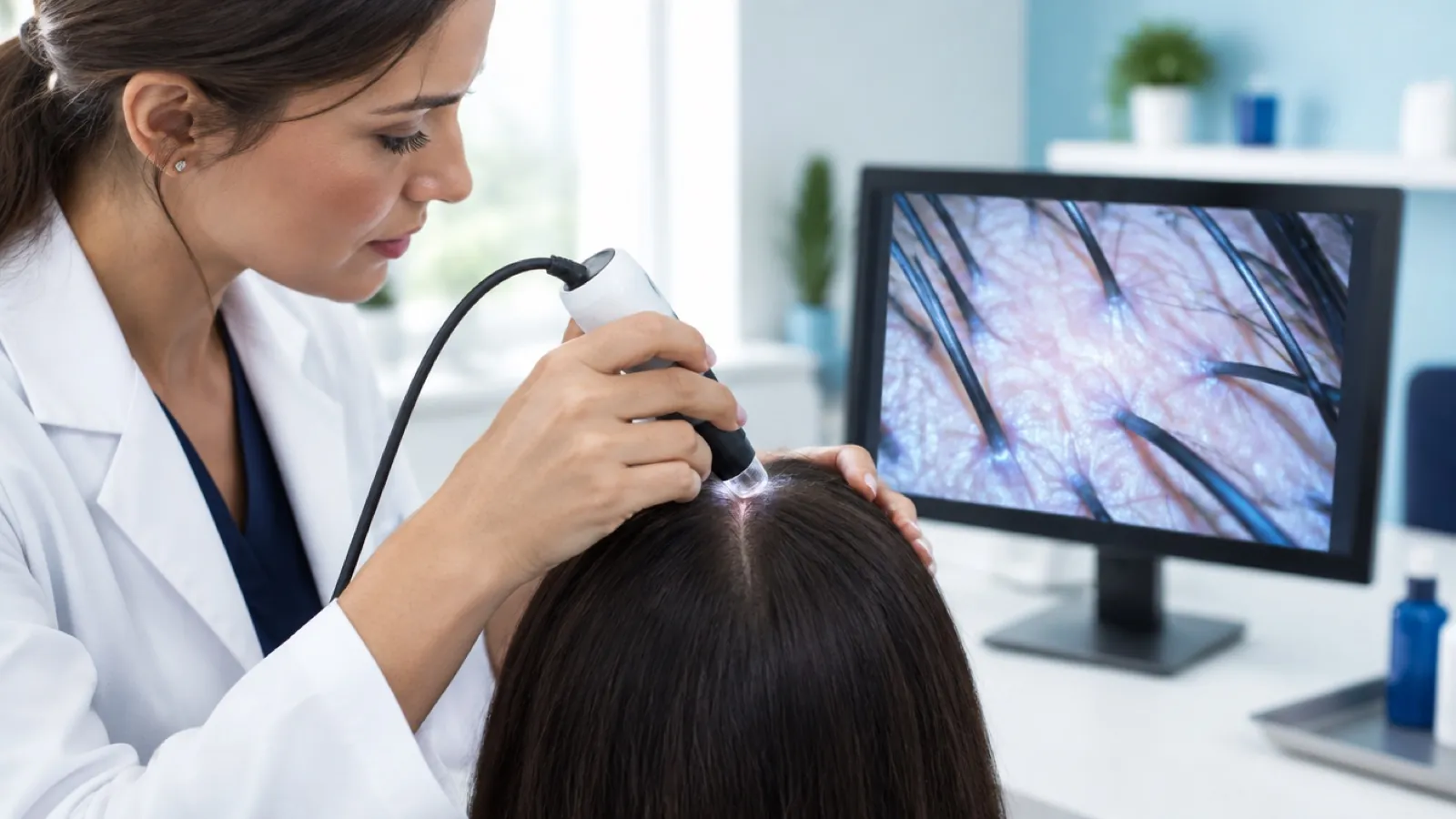
What is trichoscopy? A plain guide to scalp dermoscopy: how a trichoscope works, what it shows, who uses it, and how it compares with a biopsy or pull test.
Best Scalp Camera for Salon Use: What to Compare First
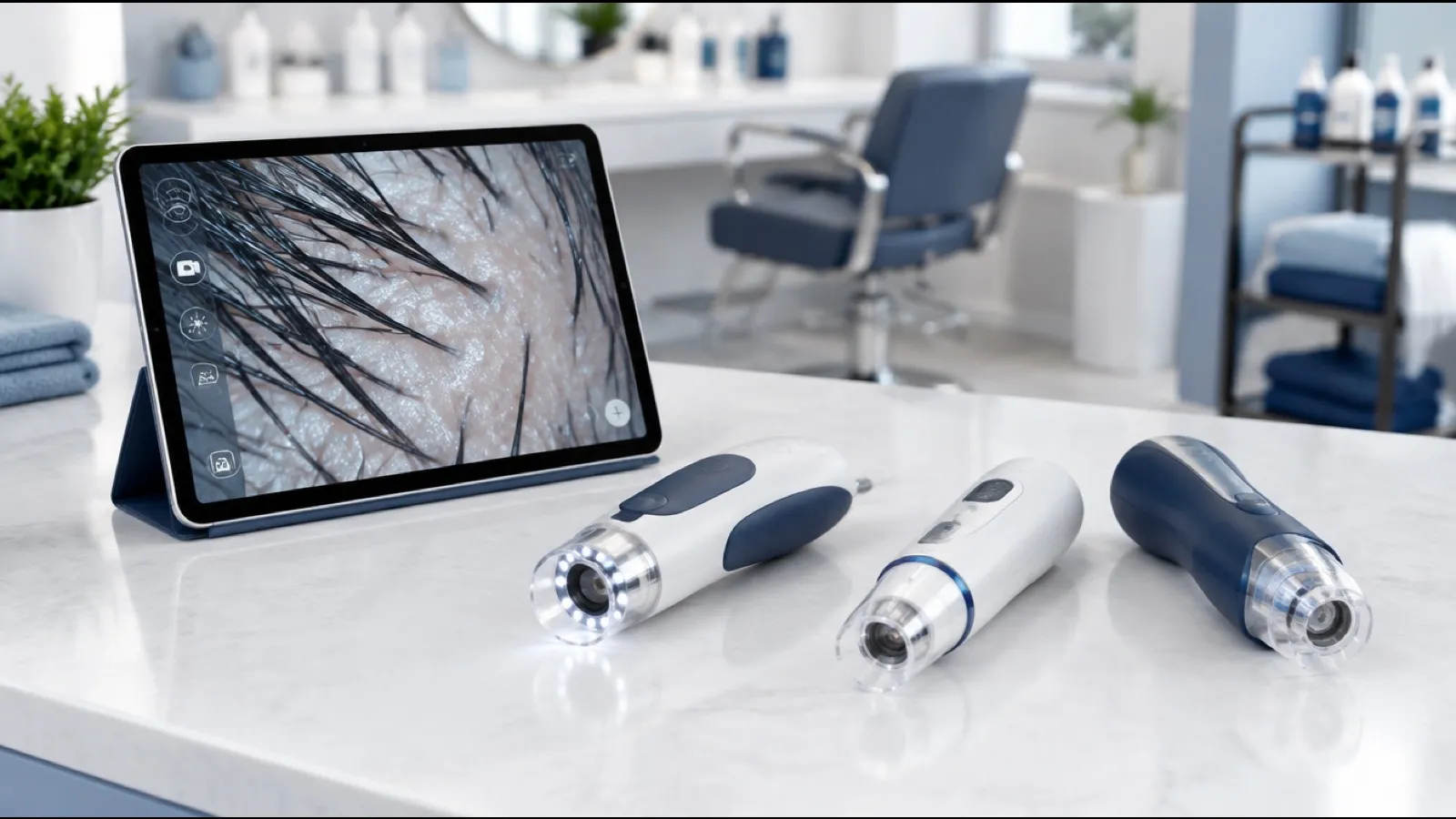
The best scalp camera for salon use is the one that gives clear, repeatable images. Compare magnification, lighting, storage, display and tip hygiene.

Hair and Scalp Consultation: Full Guide and Intake Form
A hair and scalp consultation in six stages, with a ready-to-copy intake question list, an observation checklist, summary wording and a follow-up schedule.