

Dandruff vs Dry Scalp vs Buildup: A Stylist's Guide
Dandruff vs dry scalp vs product buildup: how the flakes differ, how seborrheic dermatitis and scalp psoriasis look, and what a stylist can do or refer.
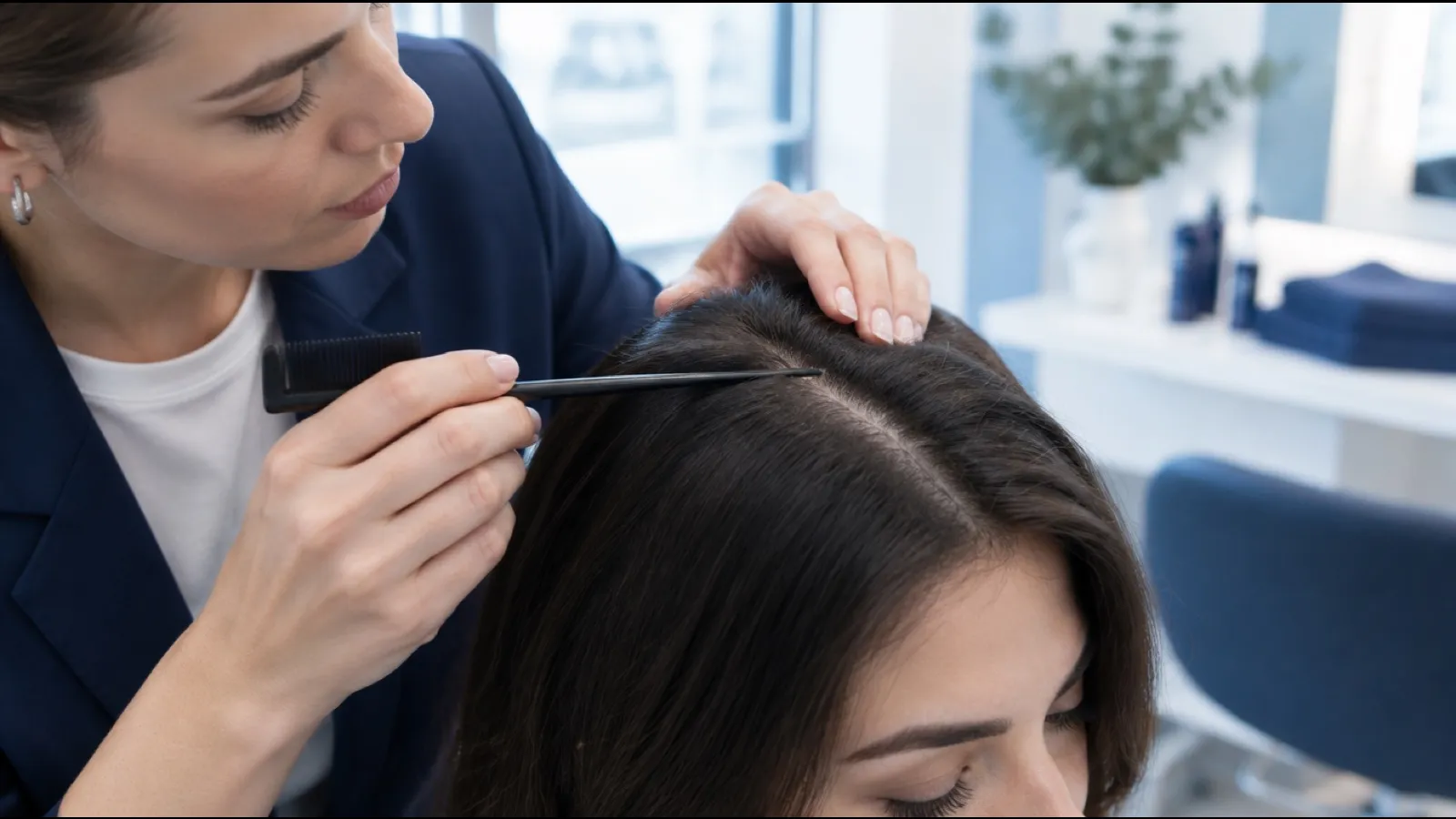
Part of the USTI scalp health guide. Start with What is scalp health?
Dandruff vs dry scalp is a question of oil and moisture. Cleveland Clinic describes dry scalp as skin that has lost too much moisture and sheds smaller flakes, while dandruff involves larger flakes and excess oil. Product buildup is a third thing entirely: residue sitting on the scalp, not skin shedding from it.
Clients call all of it "dandruff." But a flaky scalp can also be seborrheic dermatitis or scalp psoriasis, and those need a physician. This guide shows how authoritative sources describe each one, what the scalp microbiome has to do with it, and where the stylist's role ends.
Dandruff vs dry scalp: what is the difference?
Dry scalp is a moisture problem and dandruff is associated with oil. Cleveland Clinic says dry scalp occurs when the skin on the head loses too much water, causing itching and flaking with smaller flakes. It describes dandruff flakes as larger pieces of skin, linked with excess oil on the scalp.
The American Academy of Dermatology (AAD) describes dandruff as a common scalp condition in which small pieces of dry skin flake off the scalp, and notes it may also itch. So the sources do not agree on flake size alone. Look at the whole picture.
What tends to point toward dry scalp
- Fine, small, dry flakes
- Scalp looks matte, with little oil at the root
- Client reports tightness, especially in cold or low-humidity weather
- Skin elsewhere on the body is dry too
Cleveland Clinic lists causes of dry scalp that include hair products that strip natural oils, low humidity and cold weather, and aging skin. It also lists psoriasis and tinea capitis, a fungal infection, as causes of a dry, flaky scalp. So "dry scalp" can be the surface of something medical.
What tends to point toward dandruff
- Flaking with visible oil at the root
- Flakes on the shoulders and through the hair
- Itch
- A pattern that comes and goes
What does scalp buildup look like?
Scalp buildup is residue from styling products, oils, dry shampoo or infrequent cleansing that sits on the scalp and hair. It is a salon observation, not a medical diagnosis, and the major medical references do not define it as a condition. It usually looks like a film or coating, and it lifts with a thorough cleanse.
What professionals commonly observe:
- A dull, waxy or powdery film on the scalp surface and the first inch of hair
- Residue that scrapes up under a comb and looks like product, not skin
- Scalp skin underneath looks calm once cleansed
The useful test is what happens after a proper shampoo. If the scalp is clear and stays clear, buildup was likely the issue. If flaking, redness or itch returns within days, the scalp is producing it, and the client should be pointed toward a dermatologist. A scalp scope makes a surface coating easier to tell from attached scale. Our guide to scalp analysis for hairstylists covers the routine.
How do dry scalp, dandruff, seborrheic dermatitis, scalp psoriasis and buildup compare?
They overlap, which is why only a dermatologist can name them. The table gathers how the AAD and Cleveland Clinic describe the typical appearance of each. Use it to describe what you see and decide whether to refer. It is not a diagnostic tool.
| What the flakes or scale typically look like | Where | Oiliness | Itch | What a pro does | |
|---|---|---|---|---|---|
| Dry scalp | Smaller flakes (Cleveland Clinic) | Scalp, often with dry skin elsewhere | Low. Skin has lost moisture | Can itch | Review cleansing habits and stripping products. Refer if it persists or a rash appears |
| Dandruff | Flakes of skin from the scalp (AAD). Larger flakes (Cleveland Clinic) | Scalp | Associated with excess oil (Cleveland Clinic) | May itch (AAD) | Educate on regular cleansing. Refer if it does not improve or is severe |
| Seborrheic dermatitis | A scaly rash that can be dry, have greasy scale, or both (AAD). White to yellow flaking (Cleveland Clinic) | Oily areas: scalp, forehead, eyebrows, eyelids, chest, behind the ears (AAD, Cleveland Clinic) | Oily areas affected | Usually mild, can be intense on the scalp (AAD) | Refer to a dermatologist |
| Scalp psoriasis | Dandruff-like flaking with silvery-white scale and reddish patches (AAD) | Anywhere on the scalp, sometimes the entire scalp (AAD) | Dry scale with a silvery sheen (AAD) | One of the most common symptoms. Scalp can also burn or feel sore (AAD) | Refer. Never pick or force scale off |
| Product buildup | Film or residue on scalp and hair. Not a medical diagnosis | Where product is applied | Often feels coated or waxy | Variable | Cleanse thoroughly, review products, reassess next visit |
Seborrheic dermatitis vs dandruff: are they the same thing?
They sit on the same spectrum. The AAD says dandruff may be considered the mildest form of seborrheic dermatitis. The difference is that seborrheic dermatitis involves inflammation and can spread beyond the scalp, while dandruff typically stays on the scalp as flaking without a visible rash.
The AAD describes seborrheic dermatitis as a common condition that causes a scaly rash on oily areas of the body such as the scalp and face. Color varies by skin tone. In lighter skin the rash is usually red and raised. In darker skin tones, the AAD says, it tends to look pink, slightly purple, or lighter than the person's natural skin tone.
Cleveland Clinic adds that seborrheic dermatitis is not contagious and is a lifelong condition that comes and goes in flare-ups. That is worth telling an embarrassed client.
Look beyond the scalp while the client is in your chair. Flaking in the eyebrows, around the nose, or behind the ears is a reason to suggest a dermatology visit.
Scalp psoriasis vs dandruff: how do they look different?
The AAD says scalp psoriasis can look a lot like dandruff, but unlike dandruff it causes a silvery sheen and dry scale on the scalp. It lists reddish patches, some barely noticeable, along with dandruff-like flaking, silvery-white scale, itching, burning and soreness.
Other AAD descriptions that matter in the salon:
- The scalp may be so dry that the skin cracks and bleeds.
- Scratching can make the scalp bleed.
- Scratching, or using force to remove the scale, can cause hair loss.
- It can appear anywhere on the scalp and can cover the entire scalp.
For professionals, that means never picking, scraping or combing out thick scale. Tell the client what you see and refer. The AAD notes that hair tends to regrow once scalp psoriasis clears.
What is the scalp microbiome, and what does Malassezia do?
The scalp microbiome is the community of bacteria and yeasts that live on scalp skin. Malassezia yeast is a normal member of it. Cleveland Clinic states that Malassezia lives on everyone's skin and is usually harmless, but when there is too much of it, a skin reaction happens.
Research associates dandruff with a shift in balance among these residents. A 2018 study in Frontiers in Cellular and Infection Microbiology compared the scalp microbiome of 140 Indian women with healthy and dandruff scalps. It found:
- Malassezia restricta and Malassezia globosa were commonly present on the scalp in both groups.
- Two bacteria formed the core of the scalp's bacterial community. One, Propionibacterium acnes (now called Cutibacterium acnes), was associated with healthy scalps. The other, Staphylococcus epidermidis, was associated with dandruff scalps.
- The authors concluded that bacterial residents may play a role in scalp health, and that the picture is not yet fully understood.
It is one study in one population, so do not overstate it. The plain-English version for clients: everyone has yeast and bacteria on the scalp, and dandruff appears to involve the balance among them and how the skin reacts.
What are the common itchy scalp causes a stylist will see?
Itchy scalp causes range from simple dryness to conditions that need a physician. Dry scalp, dandruff, seborrheic dermatitis and scalp psoriasis can all itch, according to the AAD and Cleveland Clinic, and Cleveland Clinic also lists fungal infection (tinea capitis) among causes of a flaky scalp. Itch alone tells you little.
Note what comes with it (flakes, scale, rash, sores, hair loss), where it is, how long it has lasted, and what changed recently, such as a new product or wash routine.
What can a stylist do, and what needs a physician?
A stylist can observe, cleanse, educate on habits and products, document, and refer. A stylist does not diagnose, treat or recommend medication. The AAD advises seeing a board-certified dermatologist when dandruff does not go away with self-care or becomes severe, because many skin conditions cause an itchy, scaly scalp.
Within the stylist's role
- Cleansing habits. Ask how often the client shampoos and how they do it. The AAD notes that the right wash frequency differs by hair type: fine, straight hair on an oily scalp may need frequent washing, while coarse, curly or coily hair is washed when needed. Product applied to the scalp and never fully rinsed is a common source of buildup.
- Product choice education. Help clients see which products are meant for the hair shaft and which for the scalp.
- A thorough, gentle cleanse. No scraping or picking.
- Documentation. Dated photos with consent, and a plain description of what you saw.
Needs a physician
Cleveland Clinic advises calling a healthcare provider if changing shampoo or over-the-counter options do not work, or if there is constant itching, a red rash, or a scalp that is swollen, warm or painful to the touch. Refer as well for:
- Thick, silvery or greasy scale attached to the skin
- Cracking, bleeding, sores or crusts
- Flaking that extends to the face, eyebrows, ears or chest
- Hair loss or breakage along with scale
- Any child with a scaly, patchy scalp
- Flaking that returns within days of a thorough cleanse
The AAD warns that without care, seborrheic dermatitis scale can thicken and scratching may lead to infection, so earlier referral is better. Our article on when to refer a client to a dermatologist explains how to have that conversation.
Sorting dandruff vs dry scalp vs buildup is observation, not diagnosis. Get good at describing what you see, fix what is within your scope, and send the rest to a dermatologist. USTI's scalp health courses and the trichology pathway teach that recognize, support, refer approach in depth.
New to the field? Start with What is trichology? or look up a term in the trichology glossary.
Sources
- American Academy of Dermatology, How to treat dandruff
- American Academy of Dermatology, Seborrheic dermatitis: Overview and Signs and symptoms
- American Academy of Dermatology, Scalp psoriasis: Symptoms and 10 ways to reduce hair loss
- Cleveland Clinic, Dry Scalp
- Cleveland Clinic, Seborrheic Dermatitis
- Saxena R, et al. Comparison of Healthy and Dandruff Scalp Microbiome Reveals the Role of Commensals in Scalp Health. Frontiers in Cellular and Infection Microbiology, 2018.
Frequently asked questions
What is the difference between dandruff and dry scalp?
Cleveland Clinic explains that dry scalp happens when the skin on the head loses too much moisture, producing smaller flakes, while dandruff involves larger flakes and is linked with excess oil. Both can itch. A dry scalp tends to feel tight and look matte, while a dandruff scalp often looks oily at the root.
Is dandruff the same as seborrheic dermatitis?
They are closely related. The American Academy of Dermatology says dandruff may be considered the mildest form of seborrheic dermatitis. Seborrheic dermatitis involves inflammation and can appear beyond the scalp on oily areas such as the forehead, eyebrows, eyelids and chest. A dermatologist makes that distinction, not a stylist.
How can you tell scalp psoriasis from dandruff?
The AAD says scalp psoriasis can look a lot like dandruff, but unlike dandruff it causes a silvery sheen and dry scale. It lists reddish patches, silvery-white scale, itching, burning and soreness as symptoms. Only a dermatologist can confirm it, so a stylist who sees these features should refer.
What does scalp buildup look like?
Product buildup is a salon observation, not a medical diagnosis. It usually appears as a dull film or residue that coats the hair near the root and the scalp surface, often after heavy use of styling products, oils or dry shampoo. It typically lifts with a thorough cleanse. Flaking that returns quickly afterward suggests something else.
Is dandruff caused by a fungus?
A yeast called Malassezia is associated with dandruff and seborrheic dermatitis. Cleveland Clinic says Malassezia lives on everyone's skin and is usually harmless, but when there is too much of it a skin reaction happens. Having the yeast is normal, and Cleveland Clinic says seborrheic dermatitis is not contagious.
Can a hairstylist treat dandruff?
No. A stylist does not diagnose or treat scalp conditions. A stylist can cleanse the scalp, review how the client washes and what products they use, explain what authoritative sources say, and refer. The AAD advises seeing a board-certified dermatologist when dandruff does not improve with self-care or becomes severe.
When should a client with an itchy, flaky scalp see a doctor?
Cleveland Clinic advises contacting a healthcare provider if changing shampoo or trying over-the-counter options does not help, or if there is constant itching, a red rash, or a scalp that is swollen, warm or painful to the touch. Bleeding, thick scale, sores or hair loss with flaking are also reasons to refer.
This article is educational and is not medical advice. USTI teaches professionals to recognize, support and refer.
Become the scalp health expert in your chair.
USTI's scalp health and haircare certification program covers eleven modules, online at your own pace or live virtual, with 10 CE credits.
See the scalp health certificationRelated articles
How to Improve Scalp Health: A Step by Step Routine
How to improve scalp health in nine sourced steps: how often to wash, how to shampoo, managing flakes, sun care, and when a scalp problem needs a physician.
Itchy Scalp Causes: 10 Reasons and When to Refer
Itchy scalp causes explained with sources: the AAD's ten reasons, itch without dandruff, itch with hair loss, itch after coloring, and what a stylist can do.
Oily Scalp: Causes, Care and When to Refer
Oily scalp explained with sources: how sebum is made, what drives oil production, how often to wash oily hair, care approaches, and when to refer a client.