

Oily Scalp: Causes, Care and When to Refer
Oily scalp explained with sources: how sebum is made, what drives oil production, how often to wash oily hair, care approaches, and when to refer a client.
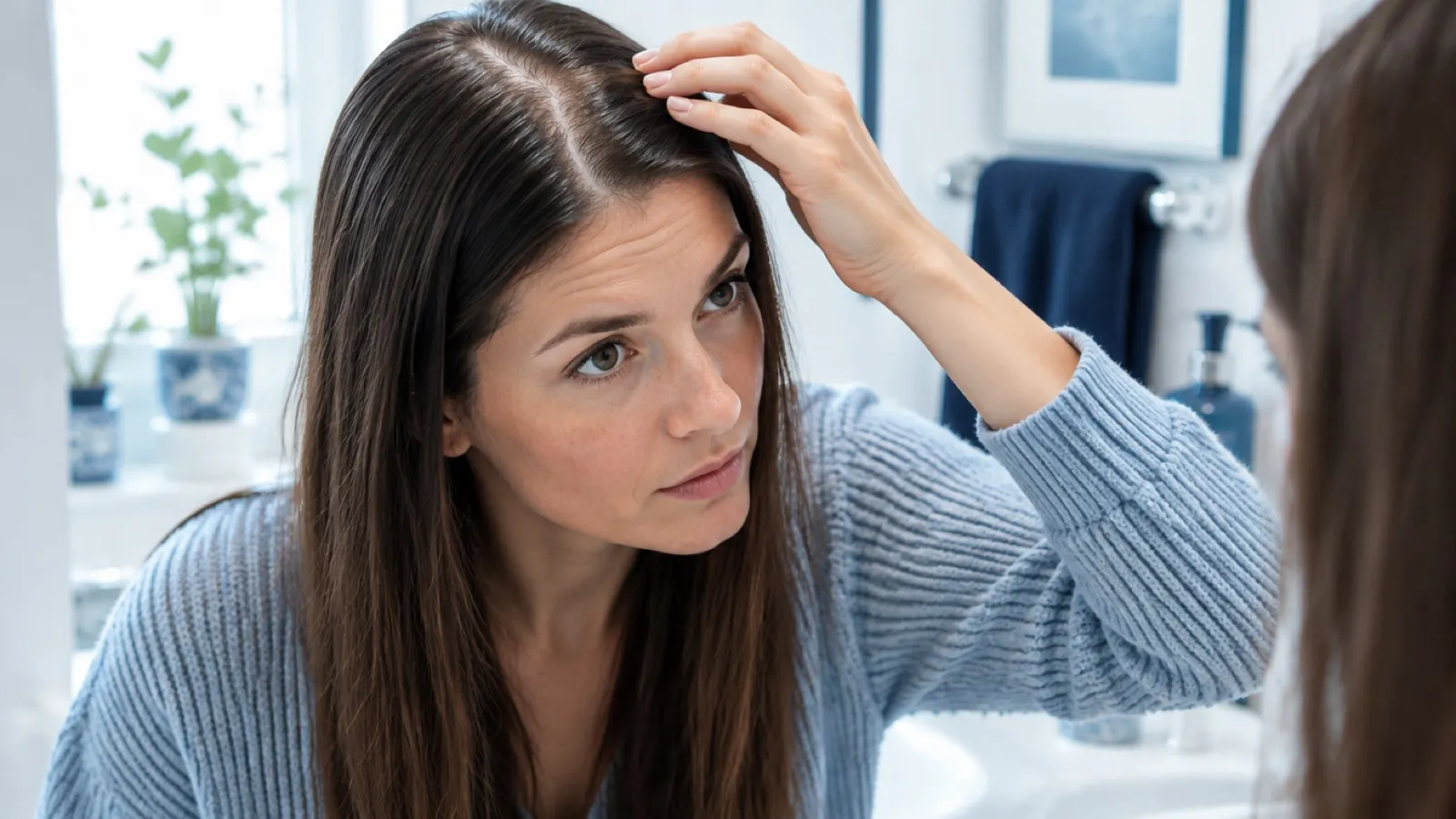
Part of the USTI scalp health guide. Start with What is scalp health?
An oily scalp is a scalp where sebum, the natural oil made by the sebaceous glands, builds up fast enough to make the roots look shiny or greasy soon after washing. Sebum is normal and protective. How much the scalp makes is governed mainly by hormones and age, not by cleanliness.
This guide explains where scalp oil comes from, what influences it, how often to wash oily hair, and which care approaches are within cosmetic scope. It also covers the point where oil with scale or redness should be referred to a physician. It is part of the USTI scalp cluster that begins with what is scalp health, and it follows from scalp types explained.
What is sebum and why does the scalp produce it?
Sebum is a mixture of lipids, or fats, made by the sebaceous glands. Cleveland Clinic describes these glands as an organ in the skin that makes and secretes sebum, and notes that the face and scalp have the most of them. The only places without sebaceous glands are the palms of the hands and the soles of the feet.
Three facts about sebum biology are useful to a hair professional.
The glands open into the hair follicle. Cleveland Clinic states that sebaceous glands secrete sebum through the hair follicles. Oil therefore arrives at the scalp surface at the base of each hair, which is why the root area looks greasy first.
The gland cells are the product. A 2009 review in the journal Dermato-Endocrinology by Picardo and colleagues describes sebum as a holocrine secretion: gland cells fill with lipid droplets, then disintegrate and release their contents into the follicle.
The composition is specific. The same review gives the make-up of human sebum:
| Sebum component | Share of total lipids |
|---|---|
| Triglycerides and fatty acids | 57.5% |
| Wax esters | 26% |
| Squalene | 12% |
| Cholesterol and its esters | 4.5% |
The authors note that squalene and wax esters are unique to sebum and are not found elsewhere in the body.
Sebum has a job. Cleveland Clinic calls it a natural lubrication that protects the skin from friction, from moisture loss or brittle hair, and from infections caused by bacteria or fungi. DermNet likewise says sebum reduces water loss from the skin surface.
What causes an oily scalp?
Oily scalp causes come down to two questions: how much sebum the glands make, and how visible that sebum becomes on the hair. The first is biological. The second depends on hair type and habits.
Hormones
DermNet states that sebum production is regulated by sex hormones called androgens, including testosterone and DHT. Cleveland Clinic dermatologist Shilpi Khetarpal, MD, puts it plainly: "Your oil glands are under the control of androgens."
DermNet also lists factors that change output. Testosterone and certain progesterones increase sebum, while oestrogens, antiandrogens and isotretinoin reduce it. These are medical matters for a physician.
Age and sex
Sebum production changes across life. According to Cleveland Clinic:
- The glands activate after birth.
- Production is slow through childhood.
- At puberty, the body produces excessive amounts of sebum.
- Production reduces to normal amounts in adulthood.
- After age 70, production slows gradually.
DermNet adds that sebum increases up to fivefold in men at puberty, that adult males produce slightly more than females, and that production declines in women after menopause. Dr Khetarpal makes the same point about menopause: a decrease in androgens leads to less oil production.
Hair type
The same amount of sebum looks different on different hair. Cleveland Clinic explains that on curly hair, oil needs to travel along corkscrew-shaped strands to reach the ends. On fine, straight hair the oil spreads quickly and shows early. This is why the AAD's wash guidance differs by hair type.
Seborrhoea and medical causes
DermNet uses the term seborrhoea for excessively oily skin due to overactive sebaceous glands, with the scalp and face most commonly affected. It notes that most people with seborrhoea have no other health problems, but that it is sometimes a sign of an underlying condition such as Parkinson disease or acromegaly, and that in women it may be due to excessive androgens associated with polycystic ovaries.
A sudden, marked change in oiliness is therefore a reason to suggest a visit to a physician.
Why is my scalp so oily even when I wash often?
The scalp is oily again soon after washing because the glands make sebum continuously, and shampoo removes only the oil already on the surface.
Does frequent washing cause harm on an oily scalp? One published study addressed this. A 2021 paper in Skin Appendage Disorders by Punyani and colleagues combined an epidemiological study with a controlled treatment study in Asian populations without specific scalp conditions. The authors reported that overall satisfaction with hair and scalp condition was achieved when washing 5 to 6 times per week, that a daily wash regimen was superior to once per week cleansing for all end points, and that concerns related to "overcleaning" were unfounded in the groups studied.
Two cautions apply. Three of the five authors were employees of a shampoo manufacturer, and the findings come from specific populations. Cleveland Clinic's Dr Khetarpal notes that over-washing leads to breakage and damage over time, and that daily washing is probably not advisable for curly hair.
How often should you wash oily hair?
Wash oily hair as often as the scalp needs, which for straight hair with an oily scalp may be every day. That is the American Academy of Dermatology's position: "If you have straight hair and an oily scalp, you may want to shampoo every day. If your hair is dry, textured, curly, or thick, shampoo when needed."
Guidance from the AAD and Cleveland Clinic lines up as follows.
| Hair and scalp | Wash frequency guidance | Source |
|---|---|---|
| Straight hair, oily scalp | May want to shampoo every day | AAD |
| Oily or greasy scalp, any type | May opt to wash daily if it bothers them | Cleveland Clinic (Khetarpal) |
| Thin, finer hair | Every one to two days | Cleveland Clinic (Khetarpal) |
| Semi-coarse hair | Every two to four days | Cleveland Clinic (Khetarpal) |
| Coarse, thick hair | Once a week, or when it needs it | Cleveland Clinic (Khetarpal) |
| Dry, textured, curly or thick hair | When needed, at least once every 2 to 3 weeks | AAD |
The AAD also notes that if flakes appear, a common reason is not shampooing frequently enough. Flake types are compared in dandruff vs dry scalp vs buildup.
How do you fix an oily scalp?
No cosmetic product changes how much sebum the glands make. "How to fix oily scalp" is better framed as how to manage surface oil so the scalp is comfortable and the hair looks clean. The approaches below are cosmetic care, not medical treatment.
| Care approach | What it does | Notes |
|---|---|---|
| Wash at the right frequency for the hair type | Removes surface oil before it builds | See the table above |
| Apply shampoo to the scalp | Cleanses where the oil is | The AAD says this washes away built-up products, dead skin and excess oil while avoiding drying the hair too much |
| Rinse thoroughly | Removes residue | The AAD notes that shampoo left on the scalp can irritate it |
| Keep conditioner on the ends | Avoids adding weight at the root | The AAD advises applying conditioner to the ends for fine or straight hair |
| Review styling products | Reduces buildup at the root | Cleveland Clinic lists product buildup among the contributors to blocked follicles on the scalp |
| Dry shampoo between washes | Absorbs oil temporarily | Cleveland Clinic says the powders absorb oil. It does not replace washing |
| Periodic exfoliation, where suitable | Lifts surface buildup | Only on intact, non-inflamed skin. See the scalp exfoliation guide |
Ingredient choices, including the role of surfactants, are covered in sulfates and silicones in hair products. The wider routine is in how to improve scalp health.
What about an oily scalp with dry ends?
Oily scalp with dry ends follows from the biology: sebum is released at the root, and the ends are the oldest part of the fiber and the furthest from the source.
The AAD's two application rules solve most of it. Shampoo goes on the scalp. Conditioner, for fine or straight hair, goes on the ends. For dry or curly hair the AAD advises applying conditioner along the entire length. Think of the scalp and the lengths as two separate care zones with different needs.
Is an oily scalp linked to hair loss?
Oil by itself is not described as a cause of hair loss in the AAD and DermNet sources reviewed for this article. The question of oily scalp and hair loss becomes relevant when oil comes with inflammation.
A 2018 review in the International Journal of Trichology by Trüeb and colleagues reports that scalp conditions such as dandruff and seborrheic dermatitis show signs of oxidative stress, and that hair from an unhealthy scalp shows altered cuticle and, in some studies, premature loss. The authors point to Malassezia, a yeast that lives on the scalp, and to free fatty acids released from sebum triglycerides. The authors were employees of, or a consultant to, a shampoo manufacturer.
The practical reading for a professional: a greasy scalp with no other signs is a care question. A greasy scalp with scale, itch, color change or thinning is a referral. Background on the yeast is in the scalp microbiome explained, and on hair change in hair shedding vs hair loss.
When does an oily scalp suggest seborrheic dermatitis?
An oily scalp suggests something more than a skin type when scale and inflammation appear with the oil. The AAD describes seborrheic dermatitis as a common skin condition that causes a scaly rash on oily areas of the body such as the scalp and face. DermNet puts its prevalence at 3% to 12% of the population.
On causes, the AAD says the exact cause is unknown but that dermatologists believe yeast that lives on everyone's skin and sebum both play a role. DermNet lists oily skin among the factors sometimes associated with more severe disease.
Signs that should prompt a referral, based on AAD descriptions:
- Scale that is greasy, dry or both
- A rash that is red and raised on lighter skin, or pink, slightly purple or lighter than the natural skin tone on darker skin
- Itch, which the AAD says is usually mild but can be intense on the scalp
- Burning
- Similar patches beyond the scalp, since the AAD notes seborrheic dermatitis can appear in other oily areas
The AAD states that many skin conditions cause similar symptoms and that an accurate diagnosis requires a board-certified dermatologist. A stylist describes what is visible and suggests the visit, without naming the condition. The recognition points are set out in the seborrheic dermatitis guide for stylists, and wording for the conversation is in when to refer a client to a dermatologist.
Where can professionals learn more about oily scalp care?
USTI's Scalp Health & Hair Care Science Certification Program includes modules on scalp and hair anatomy, scalp types and proper scalp care, hair care and scalp care ingredient science, and the flaking scalp in depth. It is designed for hairstylists, barbers, cosmetologists, educators and beauty professionals, and it teaches within a non-medical scope: recognize, support, refer.
An oily scalp is, in most cases, normal biology. Hormones and age set the output. Washing habits and product placement manage what shows. When oil arrives with scale, itch or color change, the next step is a dermatologist.
New to the field? Start with What is trichology? or look up a term in the trichology glossary.
Sources
- Cleveland Clinic: Sebaceous glands
- Cleveland Clinic: How often should you wash your hair?
- Cleveland Clinic: Pimples and acne on scalp
- DermNet: Sebum
- DermNet: Seborrhoea
- DermNet: Seborrhoeic dermatitis
- American Academy of Dermatology: Tips for healthy hair
- American Academy of Dermatology: 10 reasons your scalp itches and how to get relief
- American Academy of Dermatology: Seborrheic dermatitis overview
- American Academy of Dermatology: Seborrheic dermatitis signs and symptoms
- American Academy of Dermatology: Seborrheic dermatitis causes
- Picardo M, Ottaviani M, Camera E, Mastrofrancesco A. Sebaceous gland lipids. Dermato-Endocrinology, 2009
- Punyani S, Tosti A, Hordinsky M, Yeomans D, Schwartz J. The Impact of Shampoo Wash Frequency on Scalp and Hair Conditions. Skin Appendage Disorders, 2021
- Trüeb RM, Henry JP, Davis MG, Schwartz JR. Scalp Condition Impacts Hair Growth and Retention via Oxidative Stress. International Journal of Trichology, 2018
Frequently asked questions
What causes an oily scalp?
An oily scalp reflects how much sebum the sebaceous glands produce and how quickly it spreads along the hair. DermNet states that sebum production is regulated by hormones called androgens. Age, sex, hair type and wash habits affect how oily the scalp looks. DermNet uses the term seborrhoea for excessively oily skin due to overactive sebaceous glands.
Why is my scalp so oily even after washing?
Sebaceous glands produce sebum continuously, so oil returns after every wash. How fast it becomes visible depends on gland activity, which is hormonally controlled, and on hair type. Cleveland Clinic explains that oil travels more slowly along curly, corkscrew-shaped strands, so fine straight hair tends to look oily sooner than coarse or coily hair.
How often should you wash oily hair?
The American Academy of Dermatology says a person with straight hair and an oily scalp may want to shampoo every day, while dry, textured, curly or thick hair can be shampooed when needed. Cleveland Clinic dermatologist Shilpi Khetarpal, MD, says people with oily scalps may opt to wash daily if the oil bothers them.
How do you fix an oily scalp?
Sebum production is set by hormones and cannot be switched off by a hair product. Care focuses on managing surface oil: washing often enough for your hair type, applying shampoo to the scalp, rinsing well, and keeping conditioner on the ends. Oil with scale, redness or itch should be assessed by a dermatologist.
Can an oily scalp cause hair loss?
Oil on its own is not listed as a cause of hair loss by the American Academy of Dermatology or DermNet sources reviewed here. Oily scalp conditions that involve inflammation are a different matter. A 2018 review in the International Journal of Trichology linked unhealthy scalp conditions such as dandruff and seborrheic dermatitis with altered hair quality and premature hair loss.
Why do I have an oily scalp but dry ends?
Sebum is released at the scalp and has to travel down the hair. The ends are the oldest, most weathered part of the fiber and receive the least oil. The American Academy of Dermatology advises applying shampoo to the scalp and, for fine or straight hair, applying conditioner to the ends.
Is an oily scalp the same as seborrheic dermatitis?
No. An oily scalp is a skin type or state. Seborrheic dermatitis is a skin condition that the American Academy of Dermatology describes as causing a scaly rash on oily areas such as the scalp and face, with inflammation. Only a physician can diagnose it. Oil accompanied by scale, itch and color change is a reason to refer.
Does sebum production change with age?
Yes. Cleveland Clinic states that sebum production is slow through childhood, becomes excessive at puberty, settles to normal amounts in adulthood and slows gradually after age 70. Cleveland Clinic dermatologist Shilpi Khetarpal, MD, adds that women after menopause have a decrease in androgens, which leads to less oil production.
This article is educational and is not medical advice. USTI teaches professionals to recognize, support and refer.
Become the scalp health expert in your chair.
USTI's scalp health and haircare certification program covers eleven modules, online at your own pace or live virtual, with 10 CE credits.
See the scalp health certificationRelated articles
How to Improve Scalp Health: A Step by Step Routine
How to improve scalp health in nine sourced steps: how often to wash, how to shampoo, managing flakes, sun care, and when a scalp problem needs a physician.

Itchy Scalp Causes: 10 Reasons and When to Refer
Itchy scalp causes explained with sources: the AAD's ten reasons, itch without dandruff, itch with hair loss, itch after coloring, and what a stylist can do.
Scalp Exfoliation: How to Exfoliate Your Scalp Safely
Scalp exfoliation explained: physical vs chemical methods, salicylic acid, how often to exfoliate, who should skip it, and the professional service steps.