

How to Improve Scalp Health: A Step by Step Routine
How to improve scalp health in nine sourced steps: how often to wash, how to shampoo, managing flakes, sun care, and when a scalp problem needs a physician.
Part of the USTI scalp health guide. Start with What is scalp health?
How to improve scalp health comes down to a consistent routine: wash on a schedule that suits your scalp and hair type, put shampoo on the scalp, rinse thoroughly, manage flakes early, keep hands gentle, limit tension and heat, and protect the scalp from the sun. See a physician when a problem persists.
The scalp is skin, and it responds to steady, gentle care more than to any single product. If you want the background first, start with what is scalp health. The nine scalp care steps below are written for anyone asking how to take care of your scalp, and for stylists and barbers who teach clients. Each factual claim is attributed to its source.
Why does scalp health matter for your hair?
Scalp health matters because hair grows out of the scalp, and the condition of that skin affects the hair it produces. A review in the International Journal of Trichology, "Scalp Condition Impacts Hair Growth and Retention via Oxidative Stress" (Trüeb and colleagues, 2018), reports that hair appears to be affected by scalp condition before it emerges from the skin.
That is the reason a scalp care routine is worth the effort. For more on this link, see scalp health and hair growth.
How do you improve scalp health step by step?
Follow these nine steps. None needs special equipment, and most are small changes to what you already do.
Step 1: Wash on a schedule that fits your scalp and hair type
How often should you wash your hair? There is no single number. The American Academy of Dermatology (AAD) gives two reference points:
- If you have straight hair and an oily scalp, you may want to shampoo every day.
- If your hair is dry, textured, curly or thick, shampoo when needed, at least once every 2 to 3 weeks.
Most people sit somewhere between those two. Start from the reference point closest to your hair, then adjust. If the scalp is greasy or itchy before wash day, wash sooner. If it feels tight after washing, space washes out or change shampoo. Not sure which type you have? See scalp types explained.
Step 2: Shampoo the scalp, condition the hair
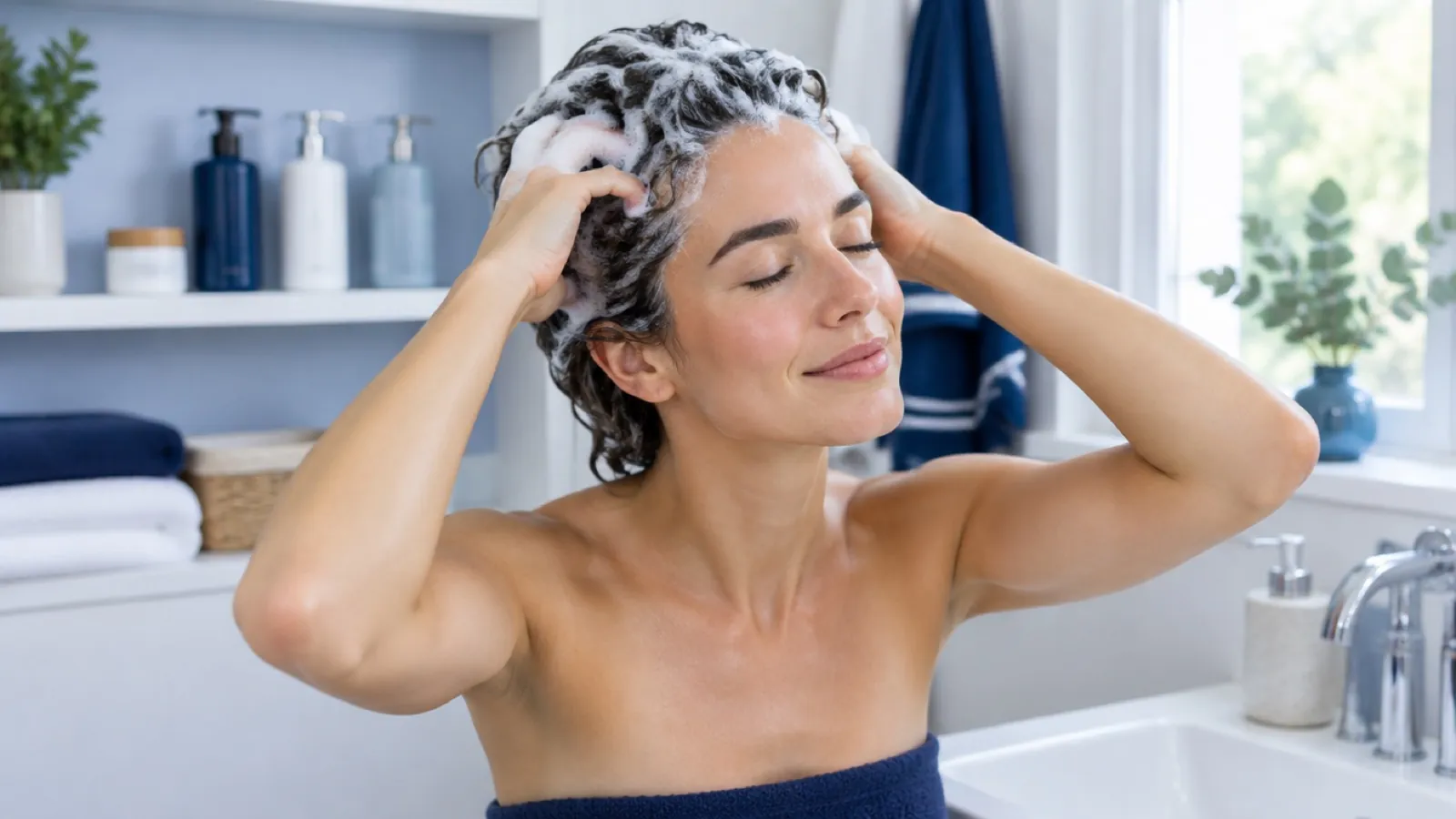
The AAD advises applying shampoo to the scalp, instead of the entire length of the hair. The scalp is where oil, sweat and product collect, so that is where the cleansing belongs. The lather that runs through the lengths as you rinse is enough for the hair.
Conditioner is for the hair fiber. The AAD says to use conditioner after washing, placed according to hair type: on the ends for fine or straight hair, along the entire length for dry or curly hair.
Step 3: Massage gently and rinse thoroughly
The AAD advises gently massaging shampoo into the scalp. Use the pads of your fingers, not your nails, and cover the whole scalp: hairline, crown, behind the ears and the nape.
Then rinse longer than you think you need to. According to the AAD, an itchy, dry and flaky scalp can be a sign that shampoo is not being rinsed out properly.
Step 4: Manage flakes early
Mild dandruff can usually be managed at home. The AAD says to look for a dandruff shampoo with one of these ingredients: zinc pyrithione, salicylic acid, sulfur, selenium sulfide, ketoconazole or coal tar. It adds three practical points:
- Follow the directions on the bottle. Some dandruff shampoos need to sit on the scalp for up to 5 to 10 minutes before rinsing.
- People with fine or straight hair or an oily scalp may need to shampoo daily and use the dandruff shampoo twice a week.
- People with coarse, curly or coily hair can wash when needed and use the dandruff shampoo about once a week, if tolerated.
The AAD also notes that coal tar shampoos can make the scalp more sensitive to the sun's UV rays.
Not all flakes are dandruff. Dandruff vs dry scalp vs buildup explains how to tell them apart.
Step 5: Do not scratch or pick
Scratching feels like relief and makes things worse. Writing about scalp psoriasis, the AAD states that rubbing, scrubbing and scratching the scalp can worsen it, that picking off scale can cause a flare, and that forcefully removing scale often loosens hair along with it. Its practical tip is to keep fingernails short and filed smooth.
The same gentle approach suits any irritated scalp. If itch is a regular problem, find the reason. Itchy scalp causes covers the common ones.
Step 6: Notice how your scalp reacts to products
A new itch or rash after a new product is a signal. The AAD explains that hair care products can cause a scalp reaction and that the fix is to stop using the product responsible. For hair dye, it names para-phenylenediamine (PPD), an ingredient found in black hair dyes, as a frequent culprit.
Introduce one new product at a time, so that a reaction can be traced. Learning how to read hair product ingredient labels makes this far easier.
Step 7: Reduce tension, heat and chemical stress
Hair practices affect the scalp as well as the fiber. The AAD's hair care advice includes:
- Wear hair loosely pulled back
- Keep weaves and extensions light so they do not pull, and wear a professional weave or extension for two or three months at most
- Use the lowest heat setting and let hair air dry when possible
- Add more time between chemical touch-ups, stretching to every 8 to 10 weeks or longer in winter
Tight styles deserve special attention, because constant pulling can lead to hair loss along the hairline. See traction alopecia early signs.
Step 8: Protect the scalp from the sun
The scalp burns like any other skin, especially along the part and where hair is thin. The AAD says that if you have thinning hair, you should either apply sunscreen to your scalp or wear a wide-brimmed hat. It recommends a sunscreen that is SPF 30 or higher, water resistant and broad spectrum, reapplied every two hours outdoors.
Step 9: Clear buildup, gently
Heavy stylers, oils and dry shampoo can leave residue that regular washing does not fully lift. An occasional deeper cleanse or exfoliating product can help. The AAD's general exfoliation advice applies: be gentle, and never exfoliate over open cuts or wounds or on sunburned skin. Our scalp exfoliation guide covers methods and limits.
What is a good scalp care routine for each scalp type?
A good scalp care routine matches wash frequency and product choice to the scalp. The table gives a starting point. Wash frequency guidance is from the AAD, and the rest is general cosmetic care to adjust for the individual.
| Scalp or hair type | Washing | Routine focus | Keep in mind |
|---|---|---|---|
| Oily scalp, straight or fine hair | May need shampoo every day (AAD) | Shampoo on the scalp, conditioner on the ends only | Rinse thoroughly. See oily scalp causes and care |
| Dry, textured, curly or thick hair | When needed, at least once every 2 to 3 weeks (AAD) | Gentle shampoo on the scalp, conditioner along the full length | Low tension styles, light extensions |
| Flaky scalp | Regular washing, with a dandruff shampoo twice a week for straight hair or an oily scalp, about once a week for coarse, curly or coily hair (AAD) | Follow the bottle directions, including leave-on time | See a dermatologist if flakes persist |
| Sensitive or reactive scalp | As tolerated | Few products, one new product at a time | Stop any product that causes a reaction (AAD) |
| Thinning hair or exposed scalp | By scalp type | Sunscreen on the scalp or a wide-brimmed hat (AAD) | Thinning itself is a reason to see a physician |
When is home care not enough?
Home care is not enough when a scalp problem is painful, persistent, spreading or linked to hair loss. Those need a physician, usually a dermatologist. Medical sources are clear on several points:
- Flaking that does not respond. The AAD says to partner with a board-certified dermatologist if dandruff does not go away with dandruff shampoo, or if it is severe.
- Suspected ringworm. The AAD states that scalp ringworm requires prescription medication. DermNet describes tinea capitis as a contagious fungal infection of the scalp that always requires systemic medication, because topical agents cannot reach the root of the hair follicle.
- Thick scale or raised patches. Scalp psoriasis and atopic dermatitis are diagnosed and managed by dermatologists.
- Sudden breakouts of bumps. The AAD describes folliculitis as an infection of the hair follicles that can look like a sudden acne breakout, and recommends a dermatologist to confirm it.
- Intense itch with no visible rash. The AAD notes this can be a sign of a nerve problem.
- A spot that itches, bleeds or will not heal. The AAD says skin cancer on the scalp may itch and should be examined by a dermatologist.
- Patches of hair loss or sudden shedding.
None of these can be settled with products, and waiting can make some of them harder to manage.
How can stylists teach clients scalp care?
Stylists and barbers see more scalps than anyone, which makes them the natural teachers of everyday scalp care. The role is recognize, support, refer. A professional does not diagnose or treat disease.
A simple way to teach scalp care at the chair:
- Look first. Check the scalp at every visit and say what you see in plain words: "there is some flaking along the hairline", not a disease name.
- Ask about the routine. Wash frequency, products, how long they rinse, how the scalp feels by day three.
- Give one or two changes. Where the shampoo goes, how long to rinse, how often to wash. Small changes are the ones clients keep.
- Write it down. A short routine card works better than a long talk.
- Recheck next visit. Photos help clients see change.
- Refer when it looks medical. Use the signs in when to refer a client to a dermatologist.
Professionals who want the science behind these conversations can study it in depth. The USTI Scalp Health & Hair Care Science Certification Program covers scalp types, ingredient science, the flaking scalp and when to refer.
Improving scalp health is mostly a matter of doing simple things consistently: wash to suit your scalp, be gentle, protect the skin, and get medical help when a problem does not settle.
New to the field? Start with What is trichology? or look up a term in the trichology glossary.
Sources
- American Academy of Dermatology: Tips for healthy hair
- American Academy of Dermatology: How to treat dandruff
- American Academy of Dermatology: 10 reasons your scalp itches and how to get relief
- American Academy of Dermatology: How to stop damaging your hair
- American Academy of Dermatology: Scalp psoriasis, 10 ways to reduce hair loss
- American Academy of Dermatology: Scalp psoriasis shampoos, scale softeners and other treatments
- American Academy of Dermatology: How to apply sunscreen
- American Academy of Dermatology: How to safely exfoliate at home
- American Academy of Dermatology: Folliculitis
- DermNet: Tinea capitis
- Trüeb RM, Henry JP, Davis MG, Schwartz JR. Scalp Condition Impacts Hair Growth and Retention via Oxidative Stress. International Journal of Trichology, 2018
Frequently asked questions
How can I improve my scalp health?
Wash on a schedule that suits your scalp and hair type, apply shampoo to the scalp, rinse it out completely, manage flakes early with a dandruff shampoo, avoid scratching and picking, limit tight styles and heat, and protect exposed scalp from the sun. See a dermatologist for anything painful, persistent or spreading.
How often should you wash your hair?
It depends on your scalp and hair type. The American Academy of Dermatology says that if you have straight hair and an oily scalp, you may want to shampoo every day. If your hair is dry, textured, curly or thick, shampoo when needed, at least once every 2 to 3 weeks.
What does a healthy scalp look like?
A healthy scalp generally looks even in tone and feels comfortable. It is free of persistent flaking, soreness, bumps and strong itch, and it is neither very greasy nor tight and dry soon after washing. Any lasting change from your own normal is worth watching, and a dermatologist can assess changes that do not settle.
Does scalp massage improve scalp health?
Gentle massage with the pads of the fingers helps spread shampoo across the scalp and feels good, and the American Academy of Dermatology advises gently massaging shampoo into the scalp. Keep the pressure light and avoid using nails. Massage is a comfort and cleansing step. It is not a medical treatment for any scalp condition.
Should I put conditioner on my scalp?
It depends on hair type. The American Academy of Dermatology advises that people with fine or straight hair apply conditioner to the ends of the hair, while people with dry or curly hair apply it to the entire length. Shampoo is the product meant for the scalp itself.
Can a stylist treat a scalp condition?
No. A stylist or barber does not diagnose or treat scalp disease. What a professional can do is notice a change, explain good scalp care, provide cosmetic services within their license, and refer the client to a dermatologist. Diagnosis and medical treatment belong to physicians.
When should I see a doctor about my scalp?
See a dermatologist if flaking does not improve with regular dandruff shampoo use, or if you have pain, open sores, pus, patches of hair loss, thick scale, intense itch or a spot that will not heal. The American Academy of Dermatology notes that scalp ringworm requires prescription medication.
This article is educational and is not medical advice. USTI teaches professionals to recognize, support and refer.
Become the scalp health expert in your chair.
USTI's scalp health and haircare certification program covers eleven modules, online at your own pace or live virtual, with 10 CE credits.
See the scalp health certificationRelated articles
Itchy Scalp Causes: 10 Reasons and When to Refer
Itchy scalp causes explained with sources: the AAD's ten reasons, itch without dandruff, itch with hair loss, itch after coloring, and what a stylist can do.
Oily Scalp: Causes, Care and When to Refer
Oily scalp explained with sources: how sebum is made, what drives oil production, how often to wash oily hair, care approaches, and when to refer a client.
Scalp Exfoliation: How to Exfoliate Your Scalp Safely
Scalp exfoliation explained: physical vs chemical methods, salicylic acid, how often to exfoliate, who should skip it, and the professional service steps.