

How to Read Hair Product Ingredient Labels: Pro Guide
Learn how to read hair product ingredient labels: FDA order rules, the 1% line, INCI names, fragrance listing and a 60-second method for stylists.
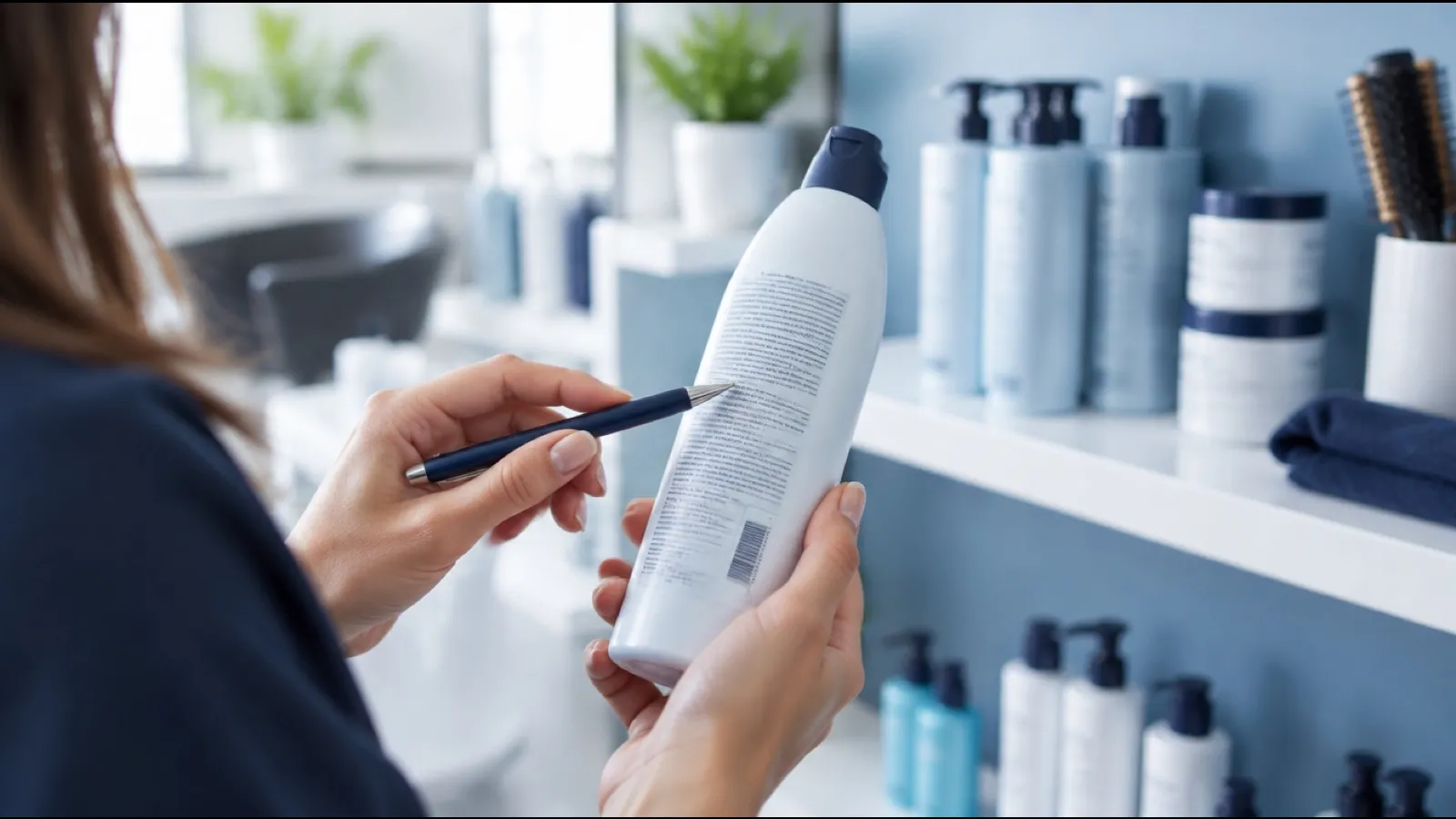
Part of the USTI scalp health guide. Start with What is scalp health?
To learn how to read hair product ingredient labels, start with one rule: US cosmetic labels list ingredients in descending order of predominance, so the first few names make up most of the bottle. After that, sort each name into a function family, find the fragrance line, and check whether the product carries a Drug Facts panel. The rest of this guide shows the rules behind that method and a 60-second routine you can use at the backbar or the retail shelf.
What rules control the ingredient order on labels?
FDA's cosmetic labeling regulation, 21 CFR 701.3, requires ingredients to be declared in descending order of predominance. Ingredients at 1% or less may be listed in any order after those above 1%. Color additives may be listed in any order after the other ingredients. Fragrance may be declared as a single word.
FDA's Cosmetics Labeling Guide lays out the main points:
- Descending order. The regulation calls for "declaration of ingredients except flavor, fragrance, and trade secret ingredients in descending order of predominance."
- The 1% rule. Ingredients present at concentrations not exceeding 1% may be listed in any order after the ingredients present above 1%.
- Color additives. The guide states that "color additives of any concentration may be listed in any order after the listing of the ingredients which are not color additives."
- Trade secrets. Where FDA has accepted an ingredient's identity as a trade secret, the label may end with the phrase "and other ingredients."
What the 1% line means in practice
The label never marks where the 1% line falls. A botanical extract near the end of a long list is present in a small amount, but the list cannot tell you how small. The reverse also holds. An ingredient listed fifth is not necessarily present in a meaningful quantity, because everything after the first few entries may already sit under 1%. Read position as a rough guide to proportion, not as a measurement.
What are INCI names on a hair product ingredients list?
INCI names are the standardized ingredient names used on cosmetic labels. INCI stands for International Nomenclature of Cosmetic Ingredients. The system is why labels read "aqua" or "water", "sodium laureth sulfate" and "cetearyl alcohol" rather than brand or trade names. Once you know the common names in each family, any hair product ingredients list becomes readable.
Three habits make INCI names easier:
- Look at word endings. Names ending in "-cone" or "-siloxane" are usually silicones. Names with "sulfate" or "sulfonate" are usually cleansing surfactants. Names with "-onium chloride" or "quaternium" are usually conditioning agents.
- Do not judge by how chemical a name sounds. Cetyl alcohol and stearyl alcohol are fatty alcohols used for conditioning and texture. They are not the same thing as drying alcohols such as alcohol denat.
- Group, then read. You do not need to memorize every name. You need to recognize which family a name belongs to and what that family does.
What ingredients should you look for in shampoo and conditioner?
Most hair products are built from the same few families: water, surfactants, conditioning agents, humectants, thickeners, preservatives, pH adjusters and fragrance. A shampoo leads with water and surfactants. A conditioner leads with water, fatty alcohols and cationic conditioning agents. Knowing the families tells you what a product is designed to do.
| Function family | What it does | Common INCI examples | Where it usually sits |
|---|---|---|---|
| Surfactants (cleansers) | Lift sebum, product and dirt so water can rinse them away | Sodium laureth sulfate, sodium lauryl sulfate, cocamidopropyl betaine, sodium lauroyl sarcosinate | Top of a shampoo list, right after water |
| Conditioning agents | Reduce friction and static, improve combing | Behentrimonium chloride, cetrimonium chloride, dimethicone, amodimethicone, cetearyl alcohol | Top of a conditioner list; lower in a shampoo |
| Humectants | Attract and hold water | Glycerin, propylene glycol, panthenol | Upper to middle |
| Preservatives | Limit microbial growth in a water-based product | Phenoxyethanol, sodium benzoate, potassium sorbate | Near the end, usually under the 1% line |
| pH adjusters | Bring the formula to its target pH | Citric acid, sodium hydroxide | Near the end |
| Fragrance | Scent, or masking of base odor | Fragrance (parfum) | Near the end |
| Color additives | Tint the product | CI numbers, FD&C or D&C names | End of the list, any order |
| Active ingredients (OTC drug products) | Deliver the drug purpose, such as dandruff control | Pyrithione zinc, selenium sulfide, salicylic acid, ketoconazole, coal tar | Separate Active Ingredients section |
For a deeper look at the two families clients ask about most, see our article on sulfates and silicones in hair products.
How is fragrance listed on labels?
FDA states that "fragrance and flavor ingredients can be listed simply as 'Fragrance' or 'Flavor.'" One word can stand for a blend of many materials. FDA explains that fragrance formulas are among the cosmetic components "most likely to be 'trade secrets,'" and the Fair Packaging and Labeling Act cannot be used to force disclosure.
Two points matter for client conversations:
- "Unscented" is not a guarantee. FDA notes that "even some products labeled 'unscented' may contain fragrance ingredients," because a manufacturer "may add just enough fragrance to mask the unpleasant smell of other ingredients."
- Allergen labeling is limited. FDA says it "does not have the same legal authority to require allergen labeling for cosmetics as for food."
If a client reports itching, burning or a rash after using a product, do not guess at the ingredient. Note the products involved and suggest an evaluation. Our guide on when to refer a client to a dermatologist covers the signs that call for a referral.
Why do some shampoos carry a Drug Facts panel?
Some hair products are regulated as both cosmetics and drugs. FDA gives the example directly: "an antidandruff shampoo is a cosmetic because its intended use is to cleanse the hair, and it is also a drug because its intended use is to treat dandruff." These products must meet the requirements for both categories.
FDA explains the labeling: drug ingredients are listed as "Active Ingredients," followed by the cosmetic ingredients "in descending order of predominance as 'Inactive Ingredients.'" On the bottle this appears as a Drug Facts panel with the active ingredient, its purpose, uses, warnings and directions.
For a professional, the panel is a signal. The product makes a drug claim, and its directions and warnings are part of how it is meant to be used. Point the client to those directions rather than writing your own. The American Academy of Dermatology lists zinc pyrithione, salicylic acid, sulfur, selenium sulfide, ketoconazole and coal tar among the dandruff shampoo actives, and advises seeing a board-certified dermatologist if dandruff does not clear. If you are unsure whether flakes are dandruff at all, read dandruff vs dry scalp vs buildup.
How do you read a hair product label in 60 seconds?
Read a label in five passes: check for a Drug Facts panel, read the first five ingredients, find the conditioning agents, find the fragrance line, then scan the tail for preservatives and colors. That sequence tells you what the product is, what it is built from and what a sensitive client may want to know.
- Seconds 0 to 10: Drug or cosmetic? Look for a Drug Facts panel or an Active Ingredients heading. If it is there, the product makes a drug claim and has its own directions.
- Seconds 10 to 25: Read the first five. These make up most of the formula. In a shampoo, identify the primary surfactant and any secondary surfactant. In a conditioner, look for fatty alcohols and a cationic agent.
- Seconds 25 to 35: Find the conditioning agents. Look for "-cone" endings, quats and polyquaterniums. Their position tells you whether conditioning is a main feature or a finishing touch.
- Seconds 35 to 45: Find fragrance. Locate "fragrance" or "parfum". Everything listed after it is usually present in small amounts. This is a practical marker, not a legal one.
- Seconds 45 to 60: Scan the tail. Note the preservatives, pH adjusters and color additives. These matter most for clients with known sensitivities confirmed by a physician.
What a label cannot tell you
A label gives names and rough order. It does not give percentages, the pH, the quality of raw materials or how the formula performs on a particular head of hair. Two products with near-identical lists can behave differently. Treat the label as the start of your assessment, and combine it with what you see during a hair and scalp consultation.
How does label reading fit into scalp education?
Reading hair product ingredient labels is a product-knowledge skill. It lets you explain function in plain terms, answer client questions without repeating marketing, and spot when a product is an OTC drug. It does not let you diagnose a reaction or a scalp condition. That stays with a dermatologist or physician.
If you want structured training in hair and scalp science, USTI's scalp health courses and the trichology pathway cover ingredients alongside scalp assessment and referral. The USTI books include ingredient-focused textbooks you can keep at your station.
Knowing how to read hair product ingredient labels will not make you a chemist. It will make you the person in the salon who can turn a long list of INCI names into a clear, honest answer.
New to the field? Start with What is trichology? or look up a term in the trichology glossary.
Sources
Frequently asked questions
What order are ingredients listed in on hair products?
In the United States, cosmetic ingredients are declared in descending order of predominance under 21 CFR 701.3. The ingredient used in the largest amount comes first. Ingredients at 1% or less may follow in any order, and color additives may be listed in any order after the other ingredients.
What is the 1% rule on cosmetic labels?
FDA's labeling rule lets a manufacturer list ingredients present at concentrations of 1% or less in any order, after the ingredients present above 1%. The label does not show where that line falls. That means position near the end of a list tells you an amount is small, but not how small.
What are INCI names?
INCI stands for International Nomenclature of Cosmetic Ingredients. It is the standardized naming system used on ingredient lists, which is why a label says sodium laureth sulfate or cetearyl alcohol instead of a trade name. Learning the common INCI names for each ingredient family makes labels from different brands comparable.
Why does a label just say fragrance?
FDA states that fragrance and flavor ingredients can be listed simply as 'Fragrance' or 'Flavor'. Fragrance formulas are complex mixtures and are among the cosmetic components most likely to be trade secrets, and the Fair Packaging and Labeling Act cannot be used to force a company to disclose trade secrets.
Does unscented mean a product has no fragrance?
Not always. FDA notes that even some products labeled 'unscented' may contain fragrance ingredients, because a manufacturer may add just enough fragrance to mask the smell of other ingredients. A client who reacts to fragrance should read the ingredient list itself and discuss confirmed allergies with a dermatologist.
Why do dandruff shampoos have a Drug Facts panel?
FDA treats an antidandruff shampoo as both a cosmetic and a drug, because it is intended to cleanse hair and to treat dandruff. Combination products carry drug and cosmetic labeling. Drug ingredients are listed as active ingredients, followed by the cosmetic ingredients as inactive ingredients in descending order of predominance.
Can a stylist tell a client which ingredient caused a reaction?
No. A stylist can read a label, explain what ingredient families do and note which products were used. Identifying the cause of a reaction is a medical question. A dermatologist can evaluate the scalp and arrange patch testing where appropriate. The stylist's role is to recognize, support and refer.
This article is educational and is not medical advice. USTI teaches professionals to recognize, support and refer.
Become the scalp health expert in your chair.
USTI's scalp health and haircare certification program covers eleven modules, online at your own pace or live virtual, with 10 CE credits.
See the scalp health certificationRelated articles
How to Improve Scalp Health: A Step by Step Routine
How to improve scalp health in nine sourced steps: how often to wash, how to shampoo, managing flakes, sun care, and when a scalp problem needs a physician.

Itchy Scalp Causes: 10 Reasons and When to Refer
Itchy scalp causes explained with sources: the AAD's ten reasons, itch without dandruff, itch with hair loss, itch after coloring, and what a stylist can do.
Oily Scalp: Causes, Care and When to Refer
Oily scalp explained with sources: how sebum is made, what drives oil production, how often to wash oily hair, care approaches, and when to refer a client.