
Scalp Microbiome Explained: Malassezia, Bacteria, Dandruff
The scalp microbiome is the community of fungi and bacteria living on the scalp. Learn what studies link to dandruff and what is still unknown.
Part of the USTI scalp health guide. Start with What is scalp health?
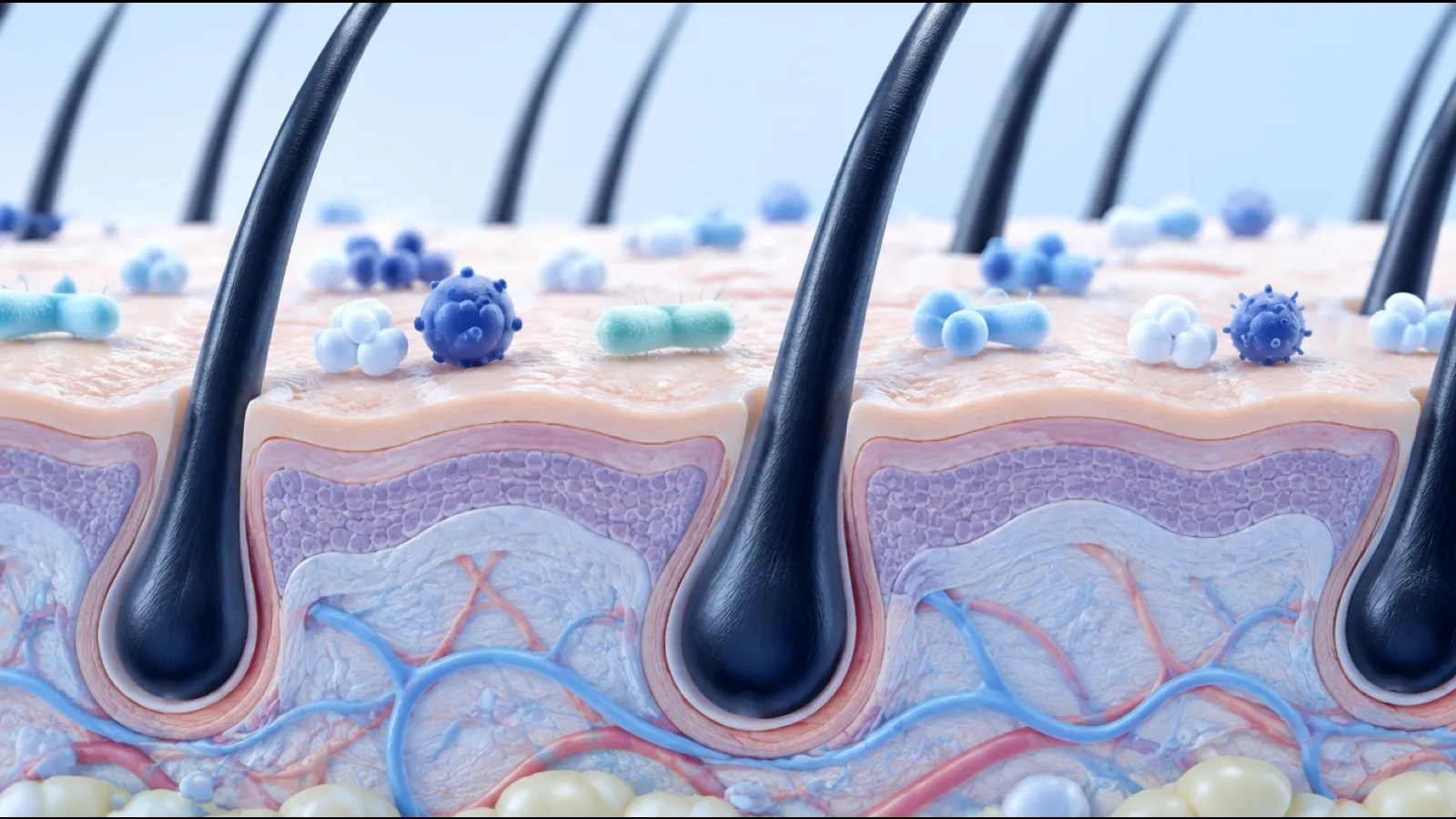
The scalp microbiome is the community of fungi and bacteria that live on the scalp, mainly Malassezia yeasts plus Cutibacterium and Staphylococcus bacteria. Everyone has one, and a healthy scalp is not a sterile scalp. Research links certain shifts in the scalp microbiome to dandruff, but those links are associations, and much about how these organisms affect scalp health is still unknown.
What lives in the scalp microbiome?
The scalp microbiome is dominated by a small number of organisms. Among fungi, Malassezia makes up most of the community. Among bacteria, Cutibacterium and Staphylococcus lead. A 2018 study in Frontiers in Cellular and Infection Microbiology reported that Propionibacterium acnes and Staphylococcus epidermidis "formed the bacterial core."
The scalp suits these organisms because it is warm, covered with hair and rich in sebum.
Malassezia: the main scalp fungus
Malassezia is a genus of yeast. The 2018 study identified several species on the scalp, including Malassezia restricta, Malassezia globosa, M. furfur and others, along with a group the authors called uncultured or uncharacterized Malassezia. Malassezia was found on healthy scalps and dandruff scalps alike.
Scalp bacteria: Cutibacterium and Staphylococcus
Cutibacterium acnes is the current name for the organism older papers call Propionibacterium acnes. A 2026 study of 63 healthy Chinese women aged 18 to 25 also found that "the predominant bacterial genera were Cutibacterium and Staphylococcus, and the fungal community was dominated by Malassezia." Two studies in two populations point to the same core residents.
What do studies say about the scalp microbiome and dandruff?
Studies find that dandruff scalps carry a different balance of the same organisms. In the 2018 study, dandruff scalps had more Staphylococcus epidermidis and a higher ratio of Malassezia restricta to Malassezia globosa. Healthy scalps had more Malassezia globosa and a higher ratio of P. acnes to S. epidermidis.
The 2018 study enrolled 140 Indian women aged 20 to 45: 70 with a healthy scalp and 70 with dandruff. Researchers sequenced bacterial and fungal DNA from scalp samples and measured dandruff scores, sebum, water loss and hydration.
| Measure | Healthy scalp group | Dandruff scalp group |
|---|---|---|
| Malassezia globosa (share of fungal reads) | 16.23% | 6.41% |
| Uncultured Malassezia species | 14.44% | 25.26% |
| Ratio of M. restricta to M. globosa | Lower | Higher |
| Fungal diversity | Lower | Higher |
| Staphylococcus epidermidis | 14.8% | 28.1% |
| Ratio of P. acnes to S. epidermidis | Higher | Lower |
The authors reported that the uncharacterized Malassezia group showed a "significant positive correlation with dandruff scores and itching." A separate 2025 study of 65 people in Frontiers in Microbiology reported a similar bacterial pattern: more Staphylococcus in the oily dandruff group and Cutibacterium in the healthy groups.
Association is not cause
These are comparisons between groups at one point in time. They show that the microbial balance differs when dandruff is present. They do not show which came first. A shift in microbes could contribute to flaking. Flaking, sebum changes or barrier changes could also reshape the microbes. Both could follow from a third factor.
The findings also come from specific populations. The 2018 authors noted that characterization "at the strain level, would be imperative" to understand population-specific differences. A pattern found in one group of women in one country may not describe every client in your chair.
What is still unknown about the scalp microbiome?
Quite a lot. The 2018 authors wrote that "the functional role of scalp microbiome, specifically the bacteriome, is yet unknown, which is essential for a better understanding of its influence on scalp health." Scientists can list which organisms are present more easily than they can explain what those organisms do.
Open questions include:
- What counts as a healthy scalp microbiome. Studies describe averages in groups. There is no agreed reference profile for an individual.
- Direction of effect. Whether microbial shifts drive dandruff or follow it.
- The role of unnamed species. The Malassezia group most correlated with dandruff scores in the 2018 study had not been characterized.
- Hair loss. A 2026 review in the International Journal of Dermatology on androgenetic alopecia described microbial differences as "preliminary evidence" and noted that findings "remain heterogenous."
- Scalp pH. Marketing often ties scalp pH to the microbiome. The studies reviewed for this article did not establish a specific scalp pH target for a balanced microbiome, so this article does not state one.
- Lifestyle factors. The 2026 study of young women observed that stress, sleep and diet patterns "tended to coincide" with shifts in Malassezia. That wording signals a tentative observation.
Does shampooing change the scalp microbiome?
Early evidence suggests it can. A 2025 study in BMC Microbiology followed scalp microbes over 28 days of shampoo use. It reported that the relative abundance of Cutibacterium rose from 11.58% to 28.66%, scalp moisture increased, and Malassezia remained the core fungus. It was one study of one shampoo.
For a professional, the practical message is modest. Cleansing habits are part of the scalp environment, and regular washing is compatible with the normal core organisms staying in place. This does not show that any particular shampoo "fixes" a microbiome.
What can "microbiome-friendly" marketing claim?
"Microbiome-friendly" is a marketing phrase, not a clinical standard. Because researchers have not defined an ideal scalp microbiome, a product cannot be shown to restore one. A cosmetic may claim to cleanse or improve appearance. A product that claims to treat dandruff or another condition is making a drug claim under FDA rules.
FDA gives the example directly: "an antidandruff shampoo is a cosmetic because its intended use is to cleanse the hair, and it is also a drug because its intended use is to treat dandruff." Those products carry a Drug Facts panel with active ingredients.
A quick way to assess a microbiome claim:
- Read the claim. "Gentle on the scalp" is a cosmetic statement. "Rebalances the microbiome to stop dandruff" is a treatment claim.
- Look for a Drug Facts panel. If the product treats dandruff, it should have one.
- Ask what was measured. A brand study showing a change in microbes is not the same as showing a healthier scalp.
- Read the label. Our guide on how to read hair product ingredient labels shows how.
What can a stylist do, and when should they refer?
A stylist can observe, educate on cleansing habits and refer. A stylist cannot test, diagnose or treat the scalp microbiome. The American Academy of Dermatology advises seeing a board-certified dermatologist when dandruff does not resolve with dandruff shampoo or is severe, because conditions such as seborrheic dermatitis, psoriasis, fungal infection or eczema may need prescription treatment.
Cleansing habits education
- Normalize the microbes. Tell clients that yeast and bacteria on the scalp are normal. This reduces shame around flaking.
- Talk about wash frequency by hair type. The AAD notes that people with fine, straight hair or an oily scalp may wash daily, while people with coarse, curly or coily hair may wash less often and apply dandruff shampoo to the scalp only.
- Point to the directions. The AAD notes that dandruff shampoos need to be lathered on the scalp, and that some need to sit before rinsing. Direct the client to the product's own directions.
- Separate flakes from residue. Not every flake is dandruff. See dandruff vs dry scalp vs buildup.
When to refer
Refer to a dermatologist or physician when you see:
- Flaking that persists despite consistent use of a dandruff shampoo
- Thick scale, marked redness, oozing, crusting or pain
- Patches of hair loss, broken hairs or tender bumps
- Symptoms that spread beyond the scalp
Our article on when to refer a client to a dermatologist gives a fuller checklist, and scalp analysis for hairstylists covers how to document what you see. USTI's scalp health courses and the trichology pathway teach scalp observation and referral in depth, and a scalp scope helps you show clients what you are seeing.
The scalp microbiome is a real and active research area. What it supports today is simple: Malassezia and scalp bacteria are normal residents, their balance differs when dandruff is present, and cause and effect are not settled. Share that with clients and refer persistent scalp problems.
New to the field? Start with What is trichology? or look up a term in the trichology glossary.
Sources
- Saxena R, et al. Comparison of Healthy and Dandruff Scalp Microbiome Reveals the Role of Commensals in Scalp Health. Frontiers in Cellular and Infection Microbiology, 2018
- Guo Y, et al. Scalp Microbiome Composition in Young Women: Associations with Scalp Type, Sensitivity, and Lifestyle Factors. Life, 2026
- Xu C, et al. High-Throughput Sequencing to Analyze Changes in the Human Scalp Microbiome During the Use of a Shampoo. BMC Microbiology, 2025
- Yu H, et al. Dysbiosis and Genomic Plasticity in the Oily Scalp Microbiome. Frontiers in Microbiology, 2025
- Gupta AK, et al. Scalp Microbiome Alterations in Androgenetic Alopecia. International Journal of Dermatology, 2026
- American Academy of Dermatology: How to treat dandruff
Frequently asked questions
What is the scalp microbiome?
The scalp microbiome is the community of microorganisms that normally live on the scalp. Sequencing studies find it is dominated by Malassezia yeasts among the fungi and by Cutibacterium and Staphylococcus among the bacteria. These organisms are present on healthy scalps too. Their presence alone is not a sign of infection or poor hygiene.
What is Malassezia?
Malassezia is a genus of yeast that makes up most of the fungal community on the human scalp. Species found in scalp studies include Malassezia restricta and Malassezia globosa. Malassezia lives on healthy scalps as well as flaking ones, so finding it does not by itself explain dandruff.
Does the scalp microbiome cause dandruff?
Studies show associations, not proof of cause. A 2018 study found different proportions of certain fungi and bacteria on dandruff scalps compared with healthy scalps. It could not show whether those shifts produce dandruff, result from it, or reflect another factor such as sebum. The authors called for further characterization.
Which bacteria live on the scalp?
The two main bacterial groups reported in scalp studies are Cutibacterium, including Cutibacterium acnes (formerly Propionibacterium acnes), and Staphylococcus, including Staphylococcus epidermidis. A 2018 study described these two species as forming the bacterial core of the scalp microbiome in both healthy and dandruff groups.
Is a microbiome-friendly shampoo better for the scalp?
There is no regulated definition of 'microbiome-friendly' that this article can point to, and scientists have not agreed on what an ideal scalp microbiome looks like. The term is a marketing description. A cosmetic can claim to cleanse. A product that claims to treat a scalp condition is making a drug claim under FDA rules.
Can a stylist test a client's scalp microbiome?
No. A stylist can observe the scalp, note flaking, oiliness, redness or odor, and educate on cleansing habits. Sequencing a microbiome is laboratory research, and interpreting scalp disease is a medical task. A stylist's role is to recognize what looks outside the ordinary, support the client, and refer to a dermatologist.
When should a client with flakes see a dermatologist?
The American Academy of Dermatology advises seeing a board-certified dermatologist if dandruff does not resolve with dandruff shampoo used as directed, or if it is severe. A dermatologist can identify conditions such as seborrheic dermatitis, psoriasis, fungal infection or eczema, which may need prescription treatment.
This article is educational and is not medical advice. USTI teaches professionals to recognize, support and refer.
Become the scalp health expert in your chair.
USTI's scalp health and haircare certification program covers eleven modules, online at your own pace or live virtual, with 10 CE credits.
See the scalp health certificationRelated articles
How to Improve Scalp Health: A Step by Step Routine
How to improve scalp health in nine sourced steps: how often to wash, how to shampoo, managing flakes, sun care, and when a scalp problem needs a physician.
Itchy Scalp Causes: 10 Reasons and When to Refer
Itchy scalp causes explained with sources: the AAD's ten reasons, itch without dandruff, itch with hair loss, itch after coloring, and what a stylist can do.
Oily Scalp: Causes, Care and When to Refer
Oily scalp explained with sources: how sebum is made, what drives oil production, how often to wash oily hair, care approaches, and when to refer a client.