

Scalp Health and Hair Growth: What Research Shows
Scalp health and hair growth: what published research shows and does not show about inflammation, oxidative stress, washing and scalp massage, with sources.
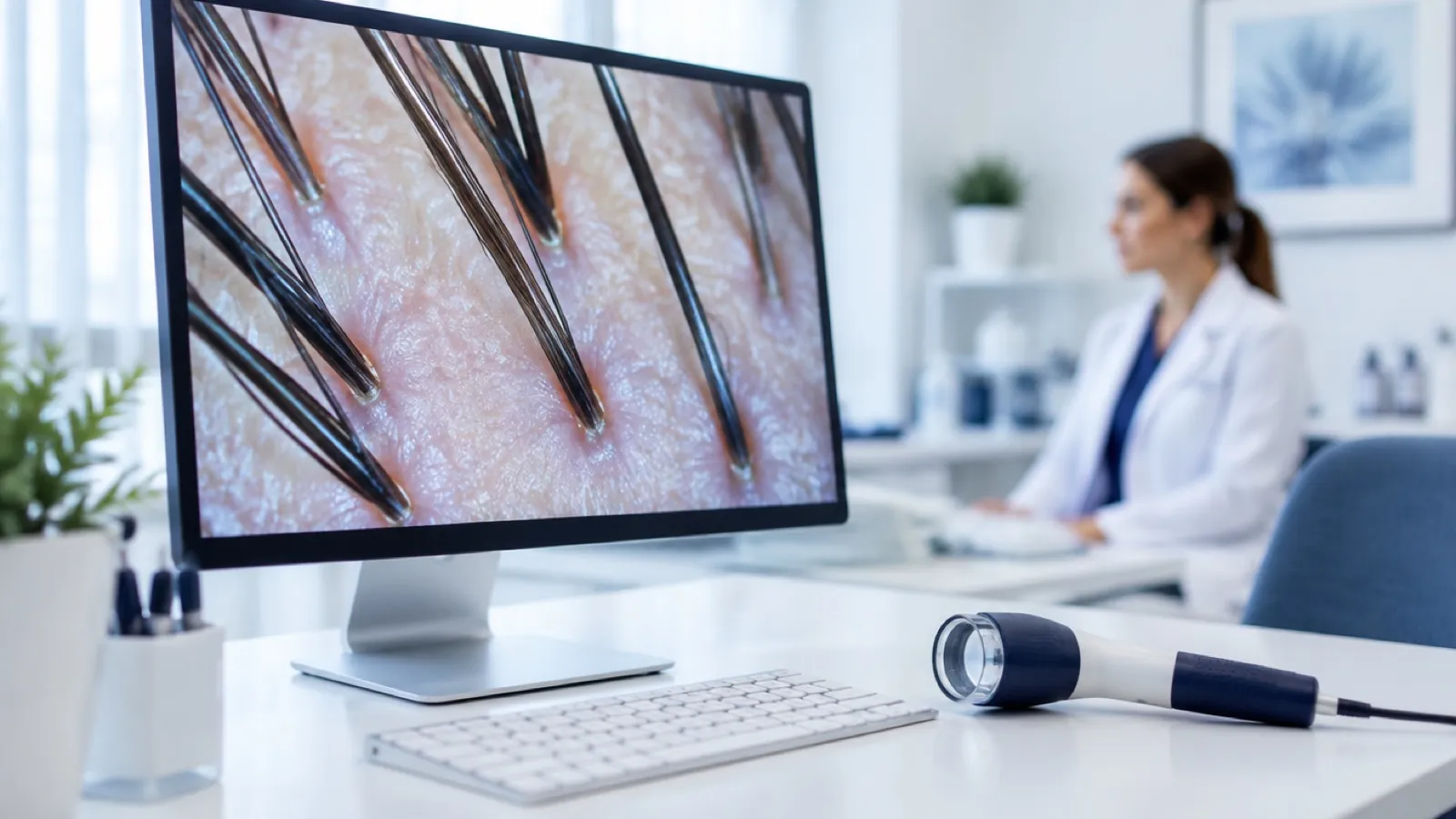
Part of the USTI scalp health guide. Start with What is scalp health?
Scalp health and hair growth are linked, but the link is narrower than marketing suggests. Published research shows that scalp conditions such as dandruff, seborrheic dermatitis and psoriasis are associated with poorer hair quality and retention. It does not show that cosmetic scalp care makes hair grow faster or regrows hair that has been lost.
This article sets out what the peer-reviewed literature does and does not show, with the size and limits of each study stated. It builds on the pillar guide, what is scalp health. USTI content is educational and non-medical: professionals recognize, support and refer, and physicians diagnose and treat.
Does scalp health affect hair growth?
Yes, to a degree that the evidence supports only in part. The hair fiber is formed inside the follicle, beneath the scalp surface. The condition of that skin is therefore part of the environment the fiber is made in. That is the reasoning behind the phrase "healthy scalp, healthy hair".
The Cleveland Clinic gives the growth phase of scalp hair as two to seven years, with growth of about 1 centimeter per month. A hair that emerges today reflects conditions in the follicle over a long period. For the cycle itself, see hair growth cycle stages.
The key paper is a 2018 review in the International Journal of Trichology by Trüeb, Henry, Davis and Schwartz, "Scalp Condition Impacts Hair Growth and Retention via Oxidative Stress". Its conclusion is that "the condition of the scalp affects the natural growth and retention of hair".
What does the research show about scalp condition and hair?
The research shows associations between unhealthy scalp conditions and three things: the quality of the hair fiber, how well hair is retained, and, in some conditions, hair density. The Trüeb review gathers this evidence. Its main findings:
- Hair is affected before it emerges. The authors write that on the scalp "the hair appears to be impacted prior to emergence".
- Fiber quality changes. Across dandruff and seborrheic dermatitis, studies report an altered cuticle with surface pitting, roughness, rigidity or breakage.
- Retention may change. Poor scalp condition "may alter the anchoring force of the fiber with the follicle".
- Psoriasis has the most data. The review describes abnormal hair shafts and decreased hair density in studies of scalp psoriasis.
The American Academy of Dermatology (AAD) adds a practical point on psoriasis: hair tends to regrow once scalp psoriasis clears. The AAD also cautions that hair loss in a person with scalp psoriasis could be caused by something else.
What is oxidative stress on the scalp?
Oxidative stress on the scalp is an excess of reactive oxygen molecules relative to the skin's capacity to neutralize them. The Trüeb review argues that it is the common thread connecting several scalp conditions to hair.
According to the review:
- Oxidative stress "appears to play a role in premature hair loss".
- The scalp yeast Malassezia, a normal resident, "has been recognized to be a source of oxidative damage".
- Dandruff and seborrheic dermatitis show raised markers of lipid peroxidation, a form of oxidative damage to oils.
- Atopic dermatitis of the head and neck is also associated with oxidative stress and sensitivity to Malassezia.
Malassezia lives on healthy scalps too. A 2026 study in the journal Life (Guo and colleagues) reports it as the dominant fungal genus on the scalp, alongside the bacteria Cutibacterium and Staphylococcus. The organism is not the problem by itself. The proposed issue is the by-products formed when it interacts with scalp oil in a susceptible person. More on this is in the scalp microbiome explained.
Can scalp inflammation cause hair loss?
Scalp inflammation can cause hair loss in specific medical conditions, and in some of them the loss is permanent. This is the strongest reason for professionals to take scalp signs seriously and refer early.
The clearest example is scarring alopecia. The Cleveland Clinic describes it as hair loss caused by hair follicle destruction and explains that inflammation destroys part of the follicle and causes scar tissue to grow, so hair cannot regenerate. Symptoms it lists include burning, crusting or scaling, and itching, tingling or tenderness. It also states that if the condition is caught very early, medication may be able to stop inflammation before the follicle is completely destroyed.
Other examples sit at different points on the scale:
| Scalp condition | What sources say about hair | Who manages it |
|---|---|---|
| Scarring alopecia | Inflammation destroys part of the follicle. Hair loss can be permanent (Cleveland Clinic) | Physician |
| Scalp psoriasis | Hair loss can occur. Hair tends to regrow once the psoriasis clears (AAD) | Physician |
| Tinea capitis | Scaling with patches of hair loss, mostly in children. Requires systemic medication (DermNet) | Physician |
| Seborrheic dermatitis and dandruff | Associated with cuticle changes and possibly weaker anchoring of the fiber (Trüeb and colleagues) | Cosmetic care for mild dandruff. Physician for seborrheic dermatitis |
| Traction from tight styles | Broken hairs, receding hairline, patches where hair is pulled. Can become permanent (AAD) | Styling change. Physician if established |
A stylist or barber does not need to name the condition. They need to recognize that redness, scale, soreness or pustules alongside thinning is a pattern for a dermatologist. See when to refer a client to a dermatologist and types of hair loss for stylists.
Does a clean scalp grow hair?
A clean scalp does not grow hair faster, as far as published evidence shows. No study we could verify demonstrates that washing increases growth rate or hair count in healthy people. What the research does address is whether washing harms or helps the condition of the scalp.
A 2021 paper in Skin Appendage Disorders (Punyani, Tosti, Hordinsky, Yeomans and Schwartz) combined a survey with a controlled study in Asian populations without scalp disease. The abstract reports that overall satisfaction with hair and scalp condition was reached when washing 5 to 6 times per week, that daily washing was superior to weekly washing on the endpoints measured, and that concerns about "overcleaning" were unfounded.
Limits to keep in view:
- The populations studied were Asian and free of scalp disease. Results may not transfer to tightly coiled or very dry hair.
- Three of the five authors were affiliated with a consumer products company.
- The endpoints were scalp and hair condition, not hair growth.
The AAD's guidance remains the practical rule: people with straight hair and an oily scalp may want to shampoo every day, and people with dry, textured, curly or thick hair can shampoo when needed, at least once every 2 to 3 weeks. Routines for different scalps are covered in how to improve scalp health.
Does scalp massage help hair growth?
Scalp massage has very little direct evidence behind it. The study quoted most often is small, and its results are mixed.
Koyama and colleagues published "Standardized Scalp Massage Results in Increased Hair Thickness by Inducing Stretching Forces to Dermal Papilla Cells in the Subcutaneous Tissue" in the journal Eplasty in 2016. The details:
- Participants: nine healthy Japanese men aged 25 to 46.
- Method: 4 minutes of massage per day with a device on one side of the scalp for 24 weeks. The other side served as the comparison.
- Hair thickness: increased from 0.085 mm to 0.092 mm at 24 weeks.
- Hair density: decreased at 12 weeks, from about 164 to about 156 hairs per square centimeter.
- Growth rate: no significant change.
- Stated limitation: the authors did not take tissue samples, so they could not examine changes in the follicles themselves.
Nine men with no hair loss, one device, and no blinding is not enough to claim that massage grows hair. The fair summary is that one small study found slightly thicker hairs and no gain in number or speed. Massage can be a pleasant part of a service and may help with product distribution and relaxation. It should not be sold as a hair growth method. The same standard is applied to another popular topic in rosemary oil for hair growth: the evidence.
What does the research not show?
The research does not show that cosmetic scalp care reverses hair loss. This is the point most often lost between a journal and an advertisement.
Specifically, the sources reviewed here do not establish that:
- A scalp scrub, serum, oil or massage regrows hair in pattern hair loss or any other diagnosed condition
- Washing more or less often changes how fast hair grows
- A scalp that looks healthy rules out a medical cause of shedding
- Associations seen in studies of scalp conditions prove cause in an individual client
There are also limits on the evidence itself. The Trüeb paper is a review, much of it built on observational studies, and it discloses that three authors were employees of a consumer products company and the fourth a consultant to it. That does not invalidate the findings, which are peer reviewed, but independent confirmation would strengthen them.
Many causes of hair loss have little to do with the scalp surface. The difference between normal shedding and loss is explained in hair shedding vs hair loss.
What can professionals do with this evidence?
Professionals can use this evidence to give honest, useful guidance: scalp care supports the skin that hair grows from, and medical hair loss needs a physician. That message protects the client and the professional.
In practice:
- Look and document. Check the scalp at each visit and record change with photos or a scalp scope. See scalp analysis for hairstylists.
- Support the skin. Recommend cleansing and cosmetic care suited to the scalp, and reduce tension and heat.
- Describe, do not diagnose. Say what is observed, such as flaking, redness or thinning at the part, without naming a disease.
- Refer early. Soreness, burning, scale or pustules with thinning is a reason for a dermatologist.
- Do not promise results. No cosmetic service guarantees growth.
USTI's Scalp Health and Hair Care Science Certification Program teaches this approach, including a module on identifying early signs of hair loss and when to refer.
Scalp health and hair growth are connected through the follicle's environment. The evidence supports caring for the scalp as skin and referring disease early. It does not support promises of regrowth.
New to the field? Start with What is trichology? or look up a term in the trichology glossary.
Sources
- Trüeb RM, Henry JP, Davis MG, Schwartz JR. Scalp Condition Impacts Hair Growth and Retention via Oxidative Stress. International Journal of Trichology, 2018
- Koyama T, Kobayashi K, Hama T, Murakami K, Ogawa R. Standardized Scalp Massage Results in Increased Hair Thickness by Inducing Stretching Forces to Dermal Papilla Cells in the Subcutaneous Tissue. Eplasty, 2016
- Punyani S, Tosti A, Hordinsky M, Yeomans D, Schwartz J. The Impact of Shampoo Wash Frequency on Scalp and Hair Conditions. Skin Appendage Disorders, 2021
- Guo and colleagues. Scalp Microbiome Composition in Young Women: Associations with Scalp Type, Sensitivity, and Lifestyle Factors. Life, 2026
- Cleveland Clinic: Scarring alopecia
- Cleveland Clinic: Hair follicle
- American Academy of Dermatology: Scalp psoriasis and hair loss
- American Academy of Dermatology: Hairstyles that pull can lead to hair loss
- American Academy of Dermatology: Tips for healthy hair
- DermNet: Tinea capitis
Frequently asked questions
Does scalp health affect hair growth?
Published research suggests it does, within limits. A 2018 review in the International Journal of Trichology concluded that the condition of the scalp affects the natural growth and retention of hair. Most of the evidence is observational and links scalp conditions with poorer hair quality. It does not show that scalp care regrows hair lost for other reasons.
Does a clean scalp grow hair faster?
No study we could verify shows that washing makes hair grow faster. A 2021 paper in Skin Appendage Disorders found that more frequent washing improved scalp and hair condition measures in people without scalp disease and caused no objective harm. That is evidence about scalp comfort and condition, not about growth rate or hair count.
Can scalp inflammation cause hair loss?
It can, in certain medical conditions. The Cleveland Clinic explains that in scarring alopecia inflammation destroys part of the follicle and scar tissue forms, so hair cannot regenerate. Other inflammatory scalp conditions, such as psoriasis, are linked with temporary hair loss. Diagnosis and treatment of these conditions belong to a physician, usually a dermatologist.
What is oxidative stress on the scalp?
Oxidative stress is an imbalance between reactive oxygen molecules and the body's ability to neutralize them. A 2018 review by Trüeb and colleagues reports that it appears to play a role in premature hair loss, that hair can be affected before it emerges from the scalp, and that the scalp yeast Malassezia is one recognized source of oxidative damage.
Does scalp massage grow hair?
The evidence is thin. In the 2016 Koyama study, nine healthy men massaged one side of the scalp for 4 minutes a day for 24 weeks. Hair thickness on that side increased slightly, but hair density decreased at 12 weeks and growth rate did not change. A study that small cannot support a claim that massage grows hair.
Can dandruff cause hair loss?
Dandruff is not listed as a direct cause of permanent hair loss in the sources reviewed here. The Trüeb review reports that dandruff and seborrheic dermatitis are associated with changes to the hair cuticle and may weaken how the fiber is anchored. Persistent flaking with hair loss should be assessed by a dermatologist, since several conditions look alike.
Can a stylist or trichology professional help with hair growth?
A professional can support the scalp with cosmetic care, reduce avoidable damage from tension, heat and harsh routines, document change with photos or a scalp scope, and refer early. They do not diagnose hair loss, prescribe or promise regrowth. Those are medical matters for a physician, and early referral is often the most useful thing a professional does.
This article is educational and is not medical advice. USTI teaches professionals to recognize, support and refer.
Become the scalp health expert in your chair.
USTI's scalp health and haircare certification program covers eleven modules, online at your own pace or live virtual, with 10 CE credits.
See the scalp health certificationRelated articles
How to Improve Scalp Health: A Step by Step Routine
How to improve scalp health in nine sourced steps: how often to wash, how to shampoo, managing flakes, sun care, and when a scalp problem needs a physician.
Itchy Scalp Causes: 10 Reasons and When to Refer
Itchy scalp causes explained with sources: the AAD's ten reasons, itch without dandruff, itch with hair loss, itch after coloring, and what a stylist can do.
Oily Scalp: Causes, Care and When to Refer
Oily scalp explained with sources: how sebum is made, what drives oil production, how often to wash oily hair, care approaches, and when to refer a client.