

Scalp Psoriasis: A Stylist's Guide to Spot and Refer
Scalp psoriasis explained for stylists: what it looks like, how it differs from dandruff and seborrheic dermatitis, coloring, hair loss and when to refer.
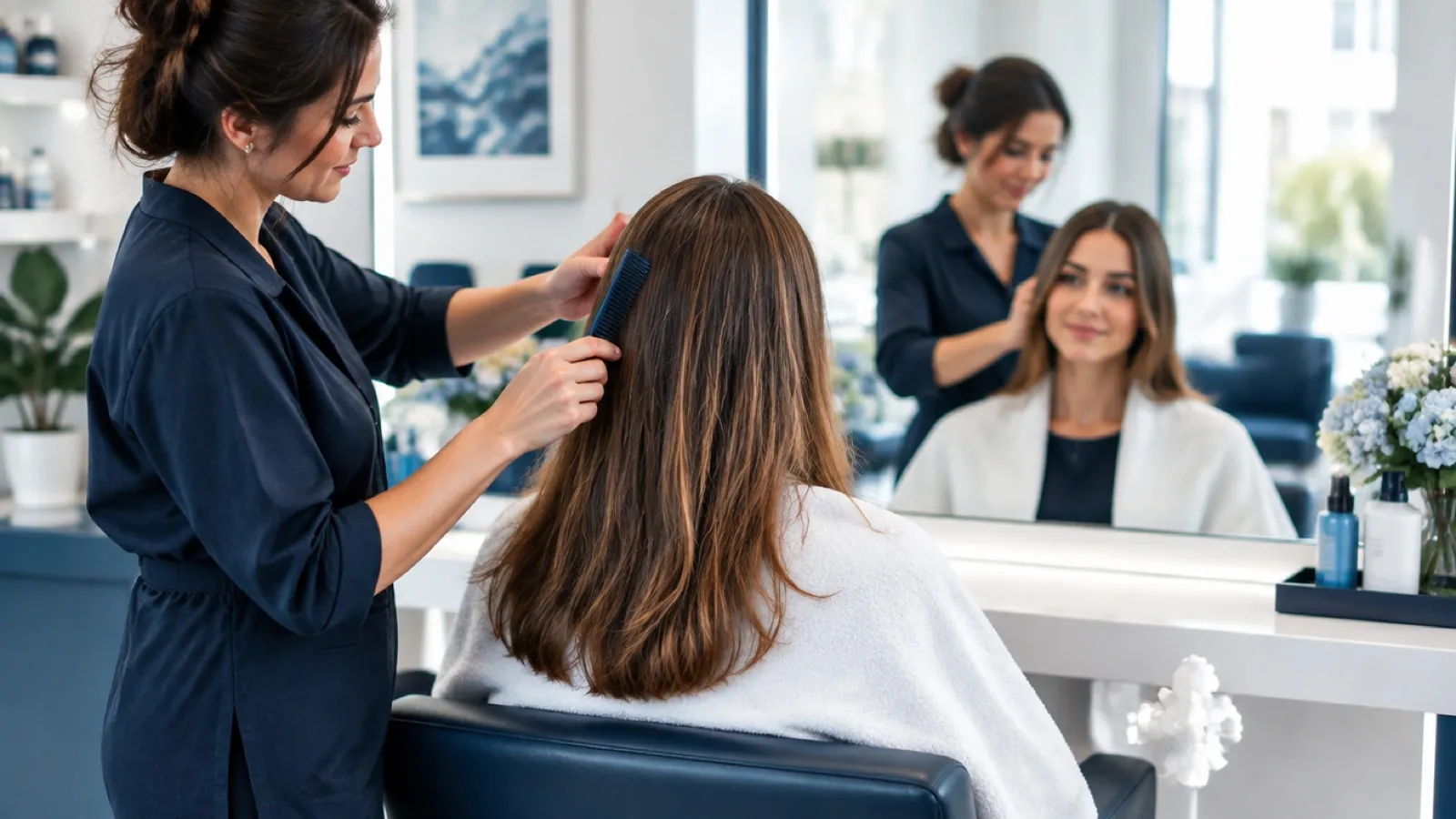
Part of the USTI scalp health guide. Start with What is scalp health?
Scalp psoriasis is psoriasis that appears on the scalp, hairline, forehead, back of the neck and skin around the ears, according to the National Psoriasis Foundation. It can look like fine, dandruff-like scaling or like thick, crusted plaques. It is a chronic, immune-related condition, and it is not contagious.
For a stylist or barber, scalp psoriasis is one of the most important flaking conditions to recognize, because the usual salon instincts (scrub it, lift the scale, carry on with the color) are the ones the medical sources warn against. This field guide sits alongside our overview of what scalp health is. Your role is to recognize, support and refer. Diagnosis and treatment belong to a physician.
What is scalp psoriasis?
The National Psoriasis Foundation (NPF) describes psoriasis as "a chronic disease that is caused by an overactive immune system and is associated with inflammation throughout the body." The American Academy of Dermatology (AAD) explains the visible result: psoriasis "causes the body to make new skin cells in days rather than weeks," and those cells pile up on the surface as thick, scaly patches called plaques.
Scalp psoriasis is that process on the scalp. The AAD says it can appear anywhere on the scalp, as a single small patch or across the whole scalp.
How common is scalp psoriasis?
The NPF reports that 52 to 80 percent of people living with psoriasis have experienced scalp psoriasis, and that up to 43% of people with psoriasis currently live with it. A stylist with a full book will meet it.
Is scalp psoriasis contagious?
No. The NPF states that psoriasis is non-infectious and that one person cannot transmit it to another by physical touch. This is worth saying out loud. Many clients with visible plaques have been treated as if they were contagious, and some avoid the salon because of it.
What does scalp psoriasis look like?
The AAD lists these signs and symptoms of scalp psoriasis:
- Reddish patches. Some are barely noticeable. Others are very noticeable, thick and inflamed.
- Dandruff-like flaking and silvery-white scale.
- A dry scalp. The AAD notes the scalp may be so dry that the skin cracks and bleeds.
- Itching, which the AAD calls one of the most common symptoms. It ranges from mild to intense.
- Bleeding, usually from scratching.
- Burning or soreness.
- Temporary hair loss.
The AAD adds that these signs can come and go. Some people have one mild flare. Others have many, from mild to serious.
What a stylist may notice
- Well-defined, raised patches with dry, silvery scale that does not brush out like loose dandruff.
- Scale that extends past the hairline onto the forehead, the nape or around the ears. The NPF names all of these areas.
- Pinpoint bleeding or scabs where the client has scratched.
- A client who flinches at the shampoo bowl or asks you to "go easy."
Scalp psoriasis on skin of color
Color is not a reliable guide on every client. The NPF says that on Caucasian skin, plaques typically appear as raised, red patches covered with a silvery white buildup, while on skin of color "the plaques may appear darker and thicker and more of a purple or grayish color or darker brown." Look for the raised edge and the dry, silvery scale.
Scalp psoriasis vs dandruff vs seborrheic dermatitis: what is the difference?
All three flake, and all three itch. The NPF gives the most useful single line: "Scalp psoriasis appears powdery with a silvery sheen, while seborrheic dermatitis looks yellowish and greasy." Dandruff, according to the AAD, flakes without inflammation.
The table sets out what the sources say. It describes observations, not diagnoses. The conditions can overlap, and telling them apart is a dermatologist's job.
| Feature | Scalp psoriasis | Seborrheic dermatitis | Dandruff |
|---|---|---|---|
| Scale | Powdery with a silvery sheen (NPF). Silvery-white and dry (AAD) | Yellowish and greasy (NPF) | Flaking without inflammation (AAD) |
| Skin underneath | Reddish patches, sometimes thick and inflamed (AAD). Purple, grayish or darker brown on skin of color (NPF) | Inflamed and discolored (AAD) | No inflammation (AAD) |
| Where it shows | Scalp, hairline, forehead, back of the neck, skin around the ears (NPF) | Scalp, ears, eyebrows, beard area, sides of the nose, chest (AAD) | Scalp |
| What the sources link it to | An overactive immune system (NPF) | Yeast on the skin and sebum. Exact cause unclear (AAD) | The AAD calls it the mildest form of seborrheic dermatitis |
| Contagious | No (NPF) | No (AAD) | No |
For the neighboring conditions, see the seborrheic dermatitis guide for stylists and dandruff vs dry scalp vs buildup. Our list of signs of an unhealthy scalp puts all of them in context.
Does scalp psoriasis cause hair loss?
It can, and the cause is often mechanical. The AAD says "scratching the scalp or using force to remove the scale can cause hair loss," and that "after the scalp psoriasis clears, hair usually regrows." The NPF says that in rare cases, severe scalp psoriasis can also cause temporary hair loss.
That matters in the salon, because a stylist's hands and tools can add to the problem. The AAD's guidance to patients on reducing hair loss includes:
- Brush and comb gently. Forcefully removing scale often loosens the hair along with it.
- Do not pick at scale. Picking can cause psoriasis to flare.
- Keep fingernails short and smooth, to avoid scratching hard enough to loosen hair or make the scalp bleed.
- Let hair air dry when possible. Blow drying can dry the scalp further.
- Test a hair care product by dabbing a small amount on the scalp before using it.
The AAD also warns that tight hairstyles can irritate the scalp, cause psoriasis to flare and, over time, cause hair loss. Our guide to traction alopecia early signs covers that risk in more detail.
Can you color hair with scalp psoriasis?
The AAD addresses this directly. It says coloring, perming or relaxing the hair "can boost your self-esteem, but they can also cause psoriasis to flare." Its advice to patients is to ask their dermatologist what is recommended, and to avoid these services when psoriasis is flaring.
In practice, that gives a stylist a clear and conservative approach:
- Ask before you mix. If a client has told you they have scalp psoriasis, ask whether it is calm or flaring and whether their dermatologist has given any guidance on chemical services.
- Look at the scalp. If you see cracked, bleeding or sore skin, reschedule the chemical service.
- Keep product off the scalp where the technique allows. Off-scalp placement, such as foils, limits contact with the skin.
- Test first. The AAD suggests dabbing a small amount of a product on the scalp and leaving it for a while before full use. Follow the manufacturer's own patch test instructions as well.
- Record what you used and how the scalp responded, so the next visit starts with information.
Do not tell a client that a color service is safe for their psoriasis. That is their dermatologist's call.
How should a hairstylist work on a client with scalp psoriasis?
Gently, and without trying to remove the scale. The AAD says rubbing, scrubbing and scratching the scalp tend to make scalp psoriasis worse, and that scratching or scraping the scalp with a brush or comb can cause a flare.
Service adjustments within cosmetic scope:
- Consult first. Ask how the scalp feels today and what the client uses on it. The hair and scalp consultation guide has a structure for this.
- Shampoo with the pads of the fingers, light pressure and lukewarm water. No nails, no scalp brush.
- Leave scale where it is. Do not lift, comb out or scrub plaques. Softening scale is part of medical care: the AAD notes that a scale softener containing salicylic acid may be used, and that decision sits with the client's dermatologist.
- Skip scalp scrubs, peels and vigorous massage on affected skin. See the scalp exfoliation guide for where exfoliation does and does not belong.
- Keep heat away from the scalp. The AAD says hot rollers and curling irons should not touch the scalp, because heat can irritate or burn it and cause a flare. Use lower dryer heat and keep the nozzle moving.
- Section with care. Clips and comb teeth should not drag across plaques. Use a soft brush, which the NPF also recommends.
- Avoid tension. Choose looser styles over tight ponytails, braids or extensions.
- Work around medicated products. If the client applies a prescribed scalp product, ask about timing so the service does not interfere.
- Offer privacy. A quieter chair or a darker cape can make the appointment easier for a client who is self-conscious about flaking.
How do you talk to a client about what you see?
If the client has already been diagnosed, follow their lead and ask what works for them. If they have not, describe what you see and recommend a dermatologist. Do not name the condition.
A script you can adapt:
"I am seeing a few raised, dry patches with some silvery flaking, here along your hairline and at the nape. I cannot tell you what it is, but it is worth showing to a dermatologist, because there are good medical options for scalp conditions. Today I am going to keep the shampoo very gentle and keep the heat off your scalp."
Avoid the words "just dandruff," and do not suggest a product to clear it. A calm, matter-of-fact tone does more for the client than reassurance you cannot back up.
When and how should you refer?
Refer any client with thick, well-defined scaly patches who has not seen a physician about them. Refer promptly when you see:
- Cracked, bleeding or very sore skin.
- Patches of hair loss.
- Scale spreading beyond the hairline.
- Intense itch that the client says disrupts sleep or daily life.
- A known psoriasis client whose scalp is clearly worse than at the last visit.
Give the client a short written note of what you observed, where and on what date. See when to refer a client to a dermatologist for wording, and our guide to itchy scalp causes for the wider picture.
What a dermatologist may recommend, according to the AAD and NPF
The NPF lists three broad groups of treatment for scalp psoriasis: topicals, phototherapy and systemic treatments. It names salicylic acid and tar as the active ingredients in over-the-counter products. The AAD advises patients to work with a board-certified dermatologist on a treatment plan, to apply medicine to the scalp and not just the hair, and to tell the dermatologist if a scalp treatment seems too harsh. It also notes that stress can worsen psoriasis.
These are medical decisions. A stylist supports the plan by keeping services gentle and consistent.
Where does this fit in a stylist's training?
Recognizing psoriasis among the flaking conditions is a core scalp skill. The USTI Scalp Health & Hair Care Science Certification Program includes a module on the flaking scalp in depth, covering dandruff, seborrheic dermatitis, psoriasis and atopic dermatitis, and a module on chemical services and their effect on scalp health.
Scalp psoriasis is common, chronic and not contagious. Recognize the silvery scale, protect the scalp during the service, and refer the client to a dermatologist.
New to the field? Start with What is trichology? or look up a term in the trichology glossary.
Sources
- National Psoriasis Foundation: Scalp Psoriasis
- National Psoriasis Foundation: About Psoriasis
- American Academy of Dermatology: Scalp psoriasis: Signs and symptoms
- American Academy of Dermatology: Scalp psoriasis: 10 ways to reduce hair loss
- American Academy of Dermatology: Hair styling tips that can reduce flares of scalp psoriasis
- American Academy of Dermatology: Scalp psoriasis: Tips for managing
- American Academy of Dermatology: Psoriasis: Overview
- American Academy of Dermatology: Seborrheic dermatitis: Overview
- American Academy of Dermatology: Seborrheic dermatitis: Causes
Frequently asked questions
What is scalp psoriasis?
Scalp psoriasis is psoriasis that appears on the scalp. The National Psoriasis Foundation describes psoriasis as a chronic disease caused by an overactive immune system. The American Academy of Dermatology says psoriasis causes the body to make new skin cells in days rather than weeks, which pile up on the surface as thick, scaly patches called plaques.
What does scalp psoriasis look like?
The American Academy of Dermatology describes reddish patches that range from barely noticeable to thick and inflamed, with dandruff-like flaking and silvery-white scale. The National Psoriasis Foundation says it can be fine scaling that looks like dandruff or thick, crusted plaques, and that on skin of color plaques may look purple, grayish or darker brown.
What is the difference between scalp psoriasis and dandruff?
Both flake, which is why they are confused. The American Academy of Dermatology says scalp psoriasis causes dandruff-like flaking but, unlike dandruff, also a silvery sheen and dry scale, usually over reddish patches. The AAD says dandruff does not cause inflammation. Only a dermatologist can confirm which one a client has.
What is the difference between scalp psoriasis and seborrheic dermatitis?
The National Psoriasis Foundation says scalp psoriasis appears powdery with a silvery sheen, while seborrheic dermatitis looks yellowish and greasy. Psoriasis is linked to an overactive immune system. The AAD links seborrheic dermatitis to skin yeast and sebum. The two can look alike on the scalp, so the distinction is for a dermatologist to make.
Can you color hair with scalp psoriasis?
The American Academy of Dermatology says coloring, perming or relaxing hair can cause psoriasis to flare. It advises patients to ask their dermatologist what is recommended and to avoid these services during a flare. It also suggests testing a hair product by dabbing a small amount on the scalp before using it.
Does scalp psoriasis cause hair loss?
It can. The American Academy of Dermatology says scratching the scalp or using force to remove scale can cause hair loss, and that hair usually regrows after the scalp psoriasis clears. The National Psoriasis Foundation says that in rare cases, severe scalp psoriasis can cause temporary hair loss.
Is scalp psoriasis contagious?
No. The National Psoriasis Foundation states that psoriasis is non-infectious and that one person cannot transmit it to another through physical touch. A stylist cannot catch it from a client, and it cannot be passed between clients on tools, capes or towels. Normal salon sanitation rules still apply to every service.
How should a hairstylist handle a client with scalp psoriasis?
Be gentle and do not pick or scrape scale. The American Academy of Dermatology says scratching or scraping the scalp with a brush or comb can cause a flare, that heat tools should not touch the scalp, and that tight hairstyles can irritate it. Avoid chemical services during a flare and recommend a dermatologist.
This article is educational and is not medical advice. USTI teaches professionals to recognize, support and refer.
Become the scalp health expert in your chair.
USTI's scalp health and haircare certification program covers eleven modules, online at your own pace or live virtual, with 10 CE credits.
See the scalp health certificationRelated articles
How to Improve Scalp Health: A Step by Step Routine
How to improve scalp health in nine sourced steps: how often to wash, how to shampoo, managing flakes, sun care, and when a scalp problem needs a physician.
Itchy Scalp Causes: 10 Reasons and When to Refer
Itchy scalp causes explained with sources: the AAD's ten reasons, itch without dandruff, itch with hair loss, itch after coloring, and what a stylist can do.
Oily Scalp: Causes, Care and When to Refer
Oily scalp explained with sources: how sebum is made, what drives oil production, how often to wash oily hair, care approaches, and when to refer a client.