

Signs of an Unhealthy Scalp: What to Look For
The signs of an unhealthy scalp, explained for stylists and clients: flaking, redness, itch, tenderness, bumps and oiliness, and which ones need a physician.
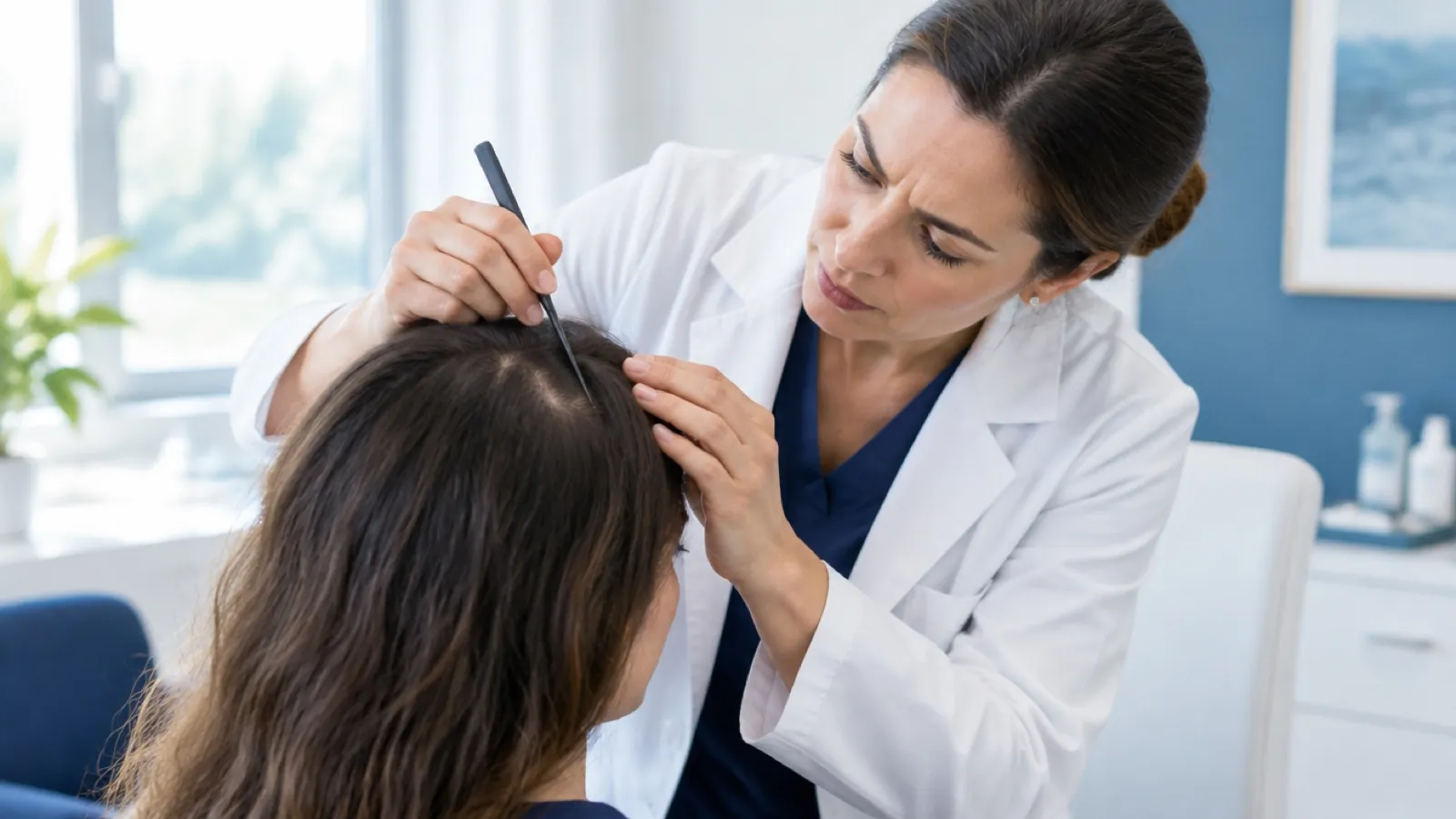
Part of the USTI scalp health guide. Start with What is scalp health?
The signs of an unhealthy scalp are visible flaking or scale, redness or other color change, persistent itch, tenderness or burning, bumps, heavy oiliness, and changes in the hair itself such as breakage or shedding. Each sign is an observation with several possible explanations. Only a physician can say which one applies.
This guide is written for stylists, barbers and other beauty professionals, and for clients who want to understand what they are seeing. It builds on the pillar article what is scalp health. For every sign below you will find what may be observed, what named medical sources say it can be associated with, and whether it sits in cosmetic care territory or needs a physician.
What is the difference between a healthy scalp and an unhealthy scalp?
A healthy scalp is comfortable and visually quiet: even in color, free of visible flakes, not itchy, not sore and not heavily oily. An unhealthy scalp shows or feels a change from that baseline. The comparison below is observational. It describes what a professional may see, not what the cause is.
| Feature | Healthy scalp | Unhealthy scalp (possible observations) |
|---|---|---|
| Color | Even, consistent with the person's skin tone | Pink, red or purple patches, or patches lighter than the surrounding skin |
| Surface | Smooth, no visible flakes or scale | Loose flakes, greasy scale, thick or silvery scale, crusts |
| Sensation | Comfortable, rarely noticed | Itch, burning, stinging, soreness or tightness |
| Oil | Light, builds gradually between washes | Heavy shine or greasiness soon after washing |
| Texture | Flat and even | Bumps, pustules, lumps or open areas |
| Hair | Consistent density, hair emerges intact | Thinning areas, broken hairs, increased shedding |
Why does the baseline matter? A 2018 review in the International Journal of Trichology by Trüeb and colleagues describes the scalp as "an incubatory environment for the preemergent hair fiber" and reports that hair emerging from an unhealthy scalp commonly shows an altered cuticle, with surface pitting, roughness or breakage. The authors were employees of, or a consultant to, a shampoo manufacturer.
What are the signs of an unhealthy scalp?
The seven signs below cover most of what a professional will observe during a scalp analysis.
1. Scalp flaking and scale
What may be observed: small loose white flakes on the scalp, hair or shoulders, or larger scale that is greasy, yellowish, thick or silvery and attached to the skin.
Possible explanations, by source:
- The American Academy of Dermatology (AAD) says common reasons for flakes include not shampooing frequently enough or not using the right conditioner, oil or scalp moisturizer for the hair type.
- The AAD states that "dandruff may be considered the mildest form of seborrheic dermatitis." DermNet describes dandruff as an uninflamed form of seborrhoeic dermatitis: diffuse bran-like scale without underlying redness.
- The AAD describes seborrheic dermatitis as a common condition that causes a scaly rash on oily areas such as the scalp and face, and says the rash can be dry, have greasy scales, or both.
- The AAD lists "dandruff-like flaking and silvery-white scale" among the symptoms of scalp psoriasis.
- DermNet lists fine scaling with patches of hair loss among the features of tinea capitis, a contagious fungal infection.
Fine, loose flaking with no redness is generally a care matter. Scale that is thick, adherent, red underneath or paired with hair loss is not. The differences are set out in dandruff vs dry scalp vs buildup and in the seborrheic dermatitis guide for stylists.
2. Scalp redness and color change
What may be observed: patches or diffuse areas that differ in color from the rest of the scalp.
Redness is not the only form this takes. The AAD notes that in darker skin tones a seborrheic dermatitis rash "tends to look pink, slightly purple, or lighter than your natural skin tone," while in lighter skin tones it is usually red and raised.
Possible explanations, by source:
- Seborrheic dermatitis, which the AAD says causes inflammation in addition to scale.
- Scalp psoriasis. The AAD lists "reddish patches on the scalp," some barely noticeable. See the scalp psoriasis guide for stylists.
- A reaction to a hair product. DermNet reports that a severe reaction to the hair dye ingredient paraphenylenediamine (PPD) can cause marked reddening, blistering and swelling of the eyelids, scalp, face and neck.
- Atopic dermatitis, which the AAD says can cause redness and scale on the scalp.
3. Persistent scalp itch
What may be observed: the client reports itching, or scratch marks are visible.
Itch is the most common scalp complaint and the least specific. A 2019 review in BioMed Research International reported that the prevalence of scalp itch in earlier studies ranged from 13 to 45%. The AAD lists ten reasons a scalp may itch, from dandruff to head lice to nerve problems. These are covered in detail in itchy scalp causes.
4. Scalp tenderness, burning or stinging
What may be observed: the client flinches during combing or shampooing, or reports soreness, burning, stinging or tightness.
Possible explanations, by source:
- Tension from styling. The AAD lists pain from tightly pulled hair and stinging on the scalp among the problems that mean a hairstyle should be changed immediately, and states: "If your hairstyle feels painful, the style is too tight." See traction alopecia early signs.
- Scalp psoriasis. The AAD lists a burning sensation or soreness among its symptoms.
- Central centrifugal cicatricial alopecia (CCCA). The AAD reports that many people with untreated CCCA say their scalp burns, stings or itches, and that early care matters because a destroyed follicle is replaced by scar tissue.
5. Scalp bumps, pustules and lumps
What may be observed: small raised or pus-filled spots, crusted spots, or a firm lump under the skin.
Possible explanations, by source:
- Folliculitis. The AAD describes folliculitis as a common skin infection that develops in the hair follicles and "usually looks like a sudden acne breakout." DermNet describes scalp folliculitis as small, very itchy pustules, often most troublesome on the frontal hairline, that become sore and crusted.
- Scalp acne. Cleveland Clinic describes pimples on the scalp or hairline linked to blocked follicles, with product buildup, sweat, oil and dead skin cells among the contributors.
- A pilar cyst. DermNet describes the trichilemmal cyst as a benign, keratin-filled cyst presenting as a firm, mobile lump of 0.5 to 5 cm, with 90% occurring on the scalp.
- Scalp ringworm. The AAD lists open sores oozing pus and a raised, soft, spongy, inflamed area among its signs.
A professional does not squeeze, lance or pick at a bump. Any spot that changes, itches or bleeds should be seen by a board-certified dermatologist, which is the AAD's guidance for skin self-exams.
6. Heavy oiliness
What may be observed: shine and greasiness at the root within a day of washing, hair that separates into strands, or oily scale.
Oil on its own is normal. Cleveland Clinic describes sebum as a natural lubrication that protects the skin. DermNet uses the term seborrhoea for excessively oily skin and notes that the affected area is often red, and that greasy and scaly patches may develop. Oil alone is a care matter. Oil with scale and redness is a reason to refer. See oily scalp causes and care.
7. Changes in the hair
What may be observed: thinning in one area, a widening part, broken hairs, bald patches or more shedding than the client is used to.
The AAD lists broken hairs around the forehead, a receding hairline and patches of hair loss where hair is pulled tightly as early signs of hair loss from tight styles. It also lists scaly bald patches and black dots in a bald area among the signs of scalp ringworm. Hair change next to a scalp sign always raises the level of concern.
Which scalp problems are cosmetic and which need a physician?
Cosmetic care covers comfort, cleansing and appearance on intact skin with mild signs. Anything that suggests infection, inflammation, scarring or an unexplained change belongs with a physician.
| What is observed | Cosmetic care territory | Refer to a physician |
|---|---|---|
| Fine, loose flakes, no color change | Yes: review wash frequency and product choice | If it persists. The AAD advises seeing a dermatologist if dandruff does not go away or is severe |
| Greasy or yellowish scale with redness or color change | No | Yes |
| Thick, silvery or adherent scale | No | Yes |
| Mild itch, no visible change | Yes: gentle cleansing, review recent products | If it persists, returns, or comes with hair loss, rash or pain |
| Itch after a color service, with rash or swelling | Stop the product | Yes |
| Heavy oil, no scale or redness | Yes | Not usually |
| Burning or tenderness with no clear reason | No | Yes |
| Pustules, crusts or open sores | No | Yes |
| A firm lump, or a spot that changes, itches or bleeds | No | Yes |
| Patchy hair loss, broken hairs with scale, or black dots | No | Yes, promptly |
The cosmetic side of this table is covered in how to improve scalp health.
What should a stylist or barber do when they see scalp problems?
A stylist or barber should describe, document and refer. A practical sequence:
- Look before the shampoo. Dry, unwashed scalp shows flaking, oil and color change most clearly.
- Ask. How long has it been there? Does it itch or hurt? Any new products, color services or tight styles?
- Describe, do not label. "I can see some scale and a pink area behind your left ear" is an observation. "You have psoriasis" is a diagnosis.
- Record. A photo or a note gives the client something to show a physician and gives you a baseline.
- Adjust the service. Avoid chemical services, heat and friction over broken, weeping or very inflamed skin.
- Refer. Suggest a board-certified dermatologist and explain that many conditions look alike.
The AAD makes the same point about look-alikes: for an accurate diagnosis of a scaly scalp rash, see a board-certified dermatologist. The full list of triggers is in when to refer a client to a dermatologist.
How can professionals learn to recognize the signs of an unhealthy scalp?
USTI's Scalp Health & Hair Care Science Certification Program is designed for hairstylists, barbers, cosmetologists, educators and beauty professionals. Its eleven modules include scalp types and proper scalp care, common scalp diseases, identifying early signs of hair loss and when to refer, and the flaking scalp in depth, covering dandruff, seborrheic dermatitis, psoriasis and atopic dermatitis.
The signs of an unhealthy scalp are few: flaking, color change, itch, tenderness, bumps, oiliness and hair change. The skill is in describing them accurately, supporting what is cosmetic, and referring the rest.
New to the field? Start with What is trichology? or look up a term in the trichology glossary.
Sources
- American Academy of Dermatology: Seborrheic dermatitis overview
- American Academy of Dermatology: Seborrheic dermatitis signs and symptoms
- American Academy of Dermatology: Scalp psoriasis symptoms
- American Academy of Dermatology: 10 reasons your scalp itches and how to get relief
- American Academy of Dermatology: Tips for healthy hair
- American Academy of Dermatology: How to treat dandruff
- American Academy of Dermatology: Hairstyles that pull can lead to hair loss
- American Academy of Dermatology: Central centrifugal cicatricial alopecia
- American Academy of Dermatology: Folliculitis
- American Academy of Dermatology: Ringworm signs and symptoms
- American Academy of Dermatology: How to perform a skin self-exam
- DermNet: Seborrhoeic dermatitis
- DermNet: Seborrhoea
- DermNet: Scalp folliculitis
- DermNet: Trichilemmal cyst
- DermNet: Tinea capitis
- DermNet: Allergy to paraphenylenediamine
- Cleveland Clinic: Sebaceous glands
- Cleveland Clinic: Pimples and acne on scalp
- Cleveland Clinic: Why is my scalp so itchy? 8 common causes
- Rattanakaemakorn P, Suchonwanit P. Scalp Pruritus: Review of the Pathogenesis, Diagnosis, and Management. BioMed Research International, 2019
- Trüeb RM, Henry JP, Davis MG, Schwartz JR. Scalp Condition Impacts Hair Growth and Retention via Oxidative Stress. International Journal of Trichology, 2018
Frequently asked questions
What are the signs of an unhealthy scalp?
The main signs of an unhealthy scalp are visible flaking or scale, redness or other color change, persistent itch, tenderness or burning, bumps or pustules, heavy oiliness, and hair that breaks or sheds more than usual. One mild sign is often a care issue. Several signs together, or any sign that persists, should be seen by a dermatologist.
What does an unhealthy scalp look like?
An unhealthy scalp may show loose white or yellowish flakes, greasy or silvery scale, pink, red or purple patches, patches lighter than the surrounding skin, crusts, pustules, or thinning areas. Appearance alone cannot name the cause. The American Academy of Dermatology notes that many skin conditions look alike and recommends a board-certified dermatologist for an accurate diagnosis.
What does a healthy scalp look like?
A healthy scalp generally has an even color that matches the person's skin tone, no visible flakes or scale, no persistent itch, soreness or tightness, and no bumps, crusts or open areas. Oil is present but not heavy within a day of washing, and the hair emerging from it looks consistent across the scalp.
Is a flaky scalp always dandruff?
No. Flaking has several possible explanations. The American Academy of Dermatology lists dandruff, reactions to hair care products, scalp psoriasis, atopic dermatitis and scalp ringworm among the reasons a scalp may flake and itch. Flaking that is thick, silvery, greasy, red underneath or paired with hair loss should be assessed by a dermatologist.
Why is my scalp tender or sore?
Scalp tenderness has many possible explanations. The American Academy of Dermatology lists pain and stinging as warning signs that a hairstyle is too tight, and says the scalp can burn or feel sore in scalp psoriasis. Burning, stinging or itching is also reported in a scarring hair loss called CCCA. Persistent tenderness warrants a medical opinion.
Can an unhealthy scalp cause hair loss?
It can be associated with it. The American Academy of Dermatology says scalp psoriasis can lead to temporary hair loss through scratching or forceful scale removal, and that scalp ringworm can cause bald patches. A 2018 review in the International Journal of Trichology linked unhealthy scalp conditions to altered hair quality and premature hair loss.
When should you see a doctor about scalp problems?
See a physician when a scalp sign persists, keeps returning, or comes with hair loss, rash or pain. That is the guidance Cleveland Clinic gives for itchy scalp. Pus, bleeding, swollen lymph nodes, patchy hair loss, or a spot that changes, itches or bleeds should be examined by a board-certified dermatologist promptly.
Can a hairstylist tell if a scalp is unhealthy?
A hairstylist can observe and describe what is visible, such as flaking, color change, bumps or thinning, and can note what the client reports. A stylist does not diagnose. The professional role is to recognize a change, support the client with appropriate cosmetic care, and refer anything that may be medical to a physician.
This article is educational and is not medical advice. USTI teaches professionals to recognize, support and refer.
Become the scalp health expert in your chair.
USTI's scalp health and haircare certification program covers eleven modules, online at your own pace or live virtual, with 10 CE credits.
See the scalp health certificationRelated articles
How to Improve Scalp Health: A Step by Step Routine
How to improve scalp health in nine sourced steps: how often to wash, how to shampoo, managing flakes, sun care, and when a scalp problem needs a physician.

Itchy Scalp Causes: 10 Reasons and When to Refer
Itchy scalp causes explained with sources: the AAD's ten reasons, itch without dandruff, itch with hair loss, itch after coloring, and what a stylist can do.
Oily Scalp: Causes, Care and When to Refer
Oily scalp explained with sources: how sebum is made, what drives oil production, how often to wash oily hair, care approaches, and when to refer a client.